What Enterprise Procurement Teams Actually Look for in a Trust Center
Procurement teams need trust centers organized by access tier, not marketing brochures.
Big-company buyers check a provider's security setup before they agree to most deals, using its trust hub. What once lived on a vendor's site as a SOC 2 badge-only marketing page has become the document repository that sets a deal's pace, pushing it toward six weeks or pulling it out to six months. Most vendors still treat it as a brochure. It doesn't work, and the gap between them is where deals stall.
In an enterprise sale, the security review takes the most time.
When buying enterprise SaaS, Security and compliance review now runs past testing the software or negotiation. There's a reason it got that way. Committees have gotten bigger, and their questionnaires have ballooned even more: Security questionnaires have expanded beyond basic encryption and access control to include subcontractor vetting, data retention schedules, and incident response timelines.
AI contracts didn't just deepen this problem incrementally, they changed it categorically. A standard SaaS agreement goes through legal review within a few weeks. An agreement involving AI now faces longer legal review cycles, as teams must examine provenance, data inputs, and subprocessor chains for AI vendors. Handling it the same way as a standard agreement jams things up right where the vendor doesn't see it coming: not at the pricing discussion, but a few weeks deep into an unbudgeted legal review.
What every stakeholder in an enterprise security review needs to see
Buying teams don't act like one person with a list. They break into separate camps, each optimizing for a goal the others ignore. Without that split, a vendor sends a penetration test report to compliance who never asked for it, while security waits.
Vendor-risk and procurement folks want up-to-date certifications with dates, paperwork, a subprocessor list, and a way to submit responses themselves instead of sitting through weeks of email back-and-forth. They’re confirming the requirements are met and the dates haven’t lapsed. Nobody goes through a penetration test report word for word, so setting up a trust center on that assumption just wastes effort.
Legal and privacy teams sit one level lower. Their ask: a Data Processing Agreement downloadable with no gatekeeper, clarity on retention and data residency, set steps for subprocessor notices, plus Standard Contractual Clauses if it crosses countries. If the DPA sits behind a rep call, legal stalls the file long before security review even begins.
InfoSec teams and Security dig the deepest, and there's one clear motive. They want system logs, management approvals, course records, and penetration test findings, because only those show a safeguard works in practice. Last year's audit in a static PDF can't tell them that now. Recent reports show Third-party roles in breaches have climbed sharply, so InfoSec teams are trusting vendor promises even less. They want ongoing insight, not a once-a-year snapshot.
What procurement teams look for in each tier
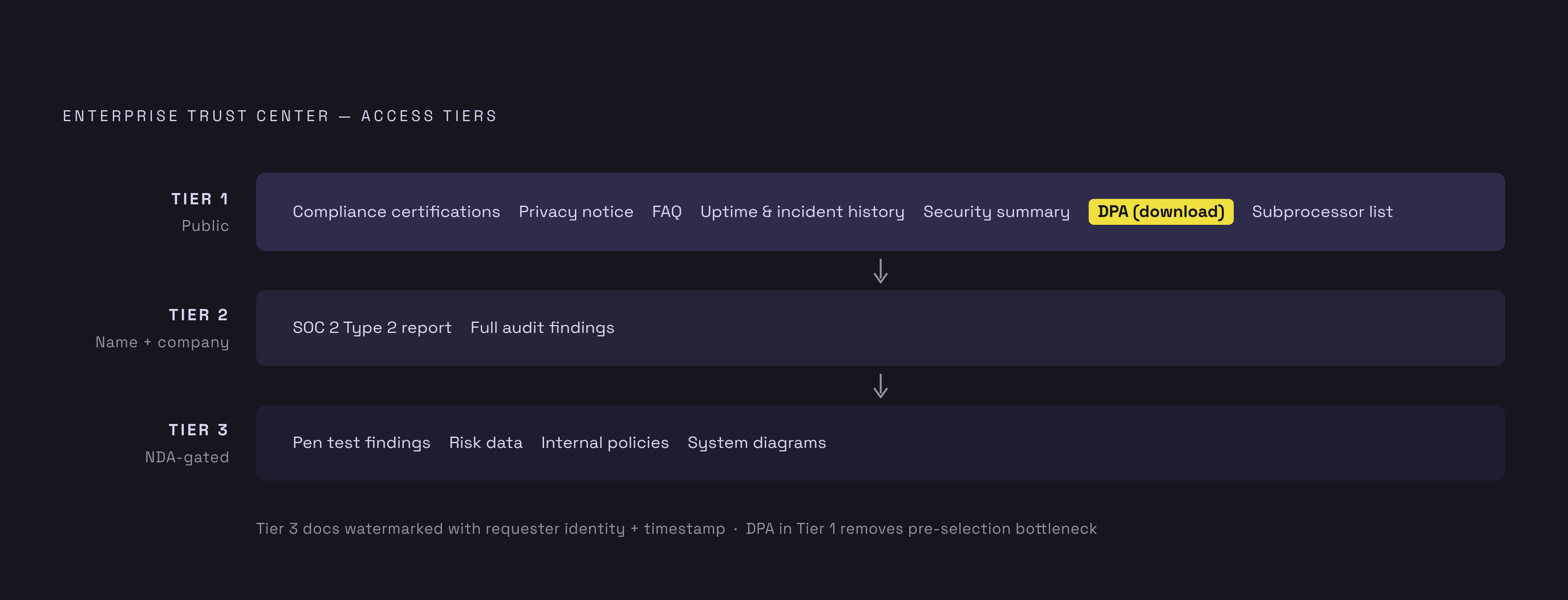
Enterprise trust centers follow a standard three-tier setup. Vendors most often misplace a document on the wrong tier, and the error almost always goes one way: gating content that ought to be public.
Don't put any friction or sign-up gates in the public tier. That's compliance certifications showing current dates and clear boundaries, the privacy notice, an FAQ or help center, uptime with incident history, a security summary, plus the DPA, all downloadable without asking. Hiding the DPA creates a bottleneck before a buyer has even picked a vendor, and it doesn't guard anything private because the DPA itself isn't private. Include the subprocessor list here too, with regions and processing details. Subprocessors must be disclosed, so keeping that record under an NDA creates unnecessary friction. It just creates friction where it shouldn't.
Prospects share their name and company to access the request-gated tier. Return only the sentence.The SOC 2 Type 2 report and full audit findings live here: too precise to share without learning who wants them, not so sensitive that they require a legal agreement.
Use the NDA-gated tier only for content that must stay private: penetration test findings, risk data, sensitive company rules, and system diagrams. A self-serve NDA signing step that opens files right away stops this tier from getting stuck, the way a slow legal review line does. Every document in this tier needs a watermark showing the requester's identity, contact, and when it was viewed. That still lets a PDF get forwarded, but any document surfacing where it shouldn't can be traced to its origin, and the traceability alone acts as a deterrent.
AI documentation now has its own place in all three tiers. Buyers now seek clarity on AI systems, data flows, and compliance documentation for AI-processed data. A vendor with nothing to say here has already taken a side. The lack of an answer reads as the warning sign.
When each certification procurement teams require comes into play
SOC 2 is still the starting point in the US, and any provider working with sensitive data without it should expect slow cycles, killed deals, and weeks of form-filling a report could have cut short. Put the SOC 3 report, public-safe, on the accessible tier. Share the complete SOC 2 Type 2 report and its specific test results only through the request gate.
Outside the US, ISO 27001 is increasingly important for EU firms, particularly those under NIS2. US enterprise procurement often requires both the certificate and the full report for review. Here, one deadline counts above everything else. After October 31, 2025, the ISO/IEC 27001:2013 transition period ended, so any certification still using the 2013 revision is expired. A vendor whose trust center still lists a 2013 certificate is presenting an invalid document. That's an invalid document, and any security reviewer aware of the date will catch it right away.
Not every vendor has ISO 42001 yet, the AI Management System Standard ISO/IEC 42001:2023. When it appears on portals such as Miro's, the shift is clear: from bonus point to must-have for any supplier of tools powered by machine-made choices.
Compliance frameworks complete the list, and procurement teams tie each one to a particular document. Medical buyers ask for the HIPAA Business Associate Agreement. EU buyers ask to see a DPA matching the region's data standard. Since January 17, 2025, DORA has bound financial-sector ICT vendors, and buyers now treat DORA readiness separately instead of folding it in with general security. DORA and NIS2 both include supply chain obligations beyond written promises, so a vendor must prove data sovereignty instead of just assert it. The UK's Cyber Security and Resilience Bill hit Parliament November 12, 2025, should move forward in 2026 to apply NIS-style obligations to outsourced IT firms, another example of rules widening.
The specific gaps that cause procurement teams to stall or kill a deal
Four gaps account for nearly every deal that stalls in security review. Most deals that get stuck in security review trace back to four gaps, and each one is avoidable.
Out-of-date or expired documents hurt the most, because they look like more than a slip. It reads like negligence. Keep the gap from a certificate's renewal to its trust center upload under 48 hours, since a static PDF out of last year's audit won't satisfy anyone who expects an ongoing posture instead of a snapshot.
A missing or buried subprocessor list is the second gap, and supply chain risk has moved to the center of procurement thinking for a concrete reason: a large share of organizations report a third-party data or privacy breach within the past year, and most UK firms still don't properly manage cyber risk from their immediate suppliers. The people approving purchases are well aware of this blind spot. That's why they dig into subprocessor chains rather than take a vendor at its word.
Gap number three is missing incident response documentation. Procurement contracts increasingly require vendors to notify buyers of security incidents and provide an incident response plan. Cybersecurity clauses are increasingly expected in procurement contracts, and vendors without a response plan may face delays. This is a contractual obligation now.
The next gap is missing continuous monitoring. Enterprise procurement increasingly favors ongoing oversight of vendors, as a single annual questionnaire may leave gaps in visibility. Buyers want up-to-date SOC 2 reports, real-time attestations, and evidence of continuous monitoring. An old audit snapshot won't convince buyers it still reflects how things run today.
How a trust center that clears procurement review actually appears
A good trust center moves things forward by serving three stakeholders directly, not by throwing up a messy stack of documents organized by file type. Vendor risk and Procurement get the subprocessor list and certifications with no friction. Legal can access the DPA and Standard Contractual Clauses from the public tier without a request. The SOC 2 Type 2 report reaches InfoSec via the request gate, and The penetration test report is accessed through a self-serve NDA flow, streamlining the review process.
All certifications stay current, properly scoped to the matching revision, without any expired ISO 27001:2013 certificates remaining after the October 2025 transition deadline. Any vendor whose service touches AI has its own AI policy area naming the systems involved, how its data moves, the vendor's stance on customer data learning, and the AI subprocessor chain, not folded into a general security FAQ that sends a reviewer searching.
The entire setup shows ongoing diligence instead of a single audit. A badge that reads "SOC 2 certified" is a claim. Continuously revised controls are the evidence, and procurement teams can now see the difference. Trust centers built for that standard are the ones that clear review. Trust centers relying solely on static badges may face longer review cycles.
Sources
- Trust Center Best Practices: 8 Things to Do in 2026
- Trust Center Software: The Ultimate Guide for 2026
- Cyber Security Procurement
- Enterprise Procurement Security: IT and Procurement Unite | Levelpath
- trust.miro.com
- Why Enterprise Software Buying Cycles Keep Lengthening
- securitypalhq.com
- securitymagazine.com