Reducing Security Review Cycle Time in Enterprise Sales
Security questionnaires now delay enterprise deals by weeks—here's how to fix it.
Enterprise SaaS deals now can run up to eighteen months from the opening talk to the signed deal, and one chunk of time, up to ten by Cyberbase, is tied to security review, due diligence questionnaires, plus contract redlining stacked with other work. That expense keeps coming back for the same reasons, sale after sale. Most vendors still leave it to chance. It behaves more as plumbing: predictable and fixable, with a price when left alone.
The slow pace makes things worse than the stats suggest. Prospeo cited Optifai's CRM-timestamp data, finding negotiation-to-close burns roughly 35 to 40% of the enterprise cycle time, mostly after it's already won based on merits. The buyer is sold on it. The internal advocate is convinced. Then it stalls, because a questionnaire still needs to be routed, or because a DPA is stuck on a person's calendar.
Clari Labs reported that 87% of businesses fell short on their 2025 sales forecasts, with much of that gap linked to underestimating how drawn-out deals get as buying committees grow. Security review is a big part in that miscalculation, and chronically underlogged. Buying committees now include six through ten stakeholders, and 77% of buyers described their most recent purchase as 'very complex or difficult', according to a benchmark. Each extra stakeholder brings another calendar to align and one more spot a security concern can surface just as the sale seems done.
It all follows a pattern. It shows up at a known stage, in a known portion of deals, for causes clear by now. So it's fixable.
The security review stage gets bigger
A substantial majority of enterprise buyers now ask for a formal security questionnaire before choosing a vendor, and late responses tack on 21 to 42 days to the sale. SyncGTM puts security review stages around 4.2 weeks long. Most vendors hit this stage unprepared, with the stat backing that up.
Volume is still rising too. Tribble.ai's benchmark indicates enterprise security fielding 23% higher vendor questionnaire volume compared to Q1 2025, driven by tighter scrutiny and expanded third-party risk efforts. That increase goes well past routine form-filling. Gartner reported 45% of companies had an interruption linked to a third-party vendor over two years, and that statistic is why vendors send these questionnaires: they see third-party problems as a documented risk, not an odd one.
Questionnaires have grown in number and changed form. SiftHub's look showed a short form turned into an assessment of 400 questions on who gets in, where info stays, AI rules, staying open, vendor threats, and how things get encrypted, all at the same time. Sprinto's work showed roughly 80% of answers in any given questionnaire were already put down before, in another place. That last 20% ties up three team members across three calendars just to nail down one approval.
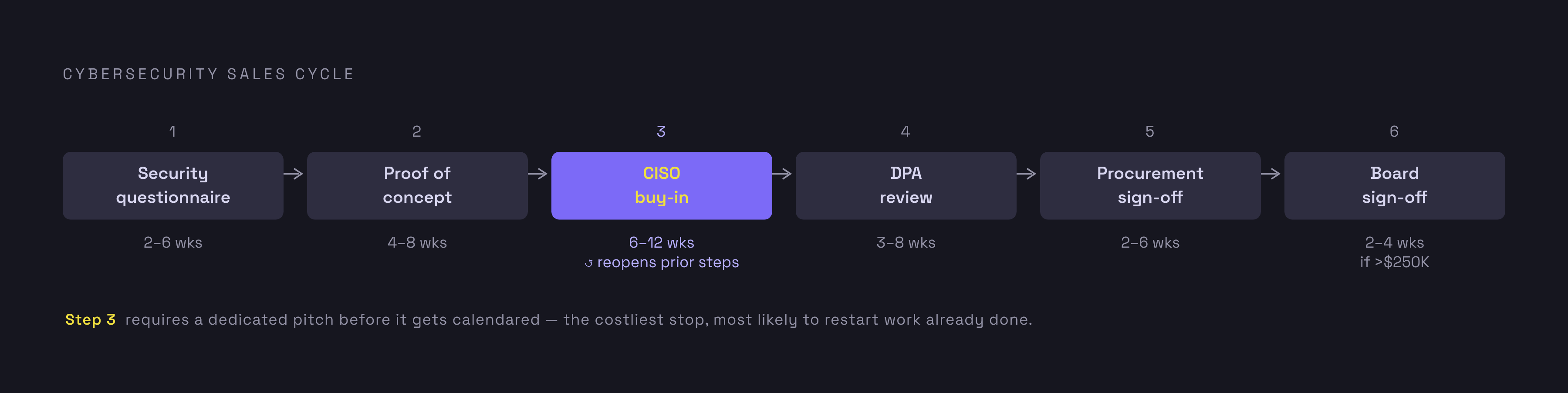
Cybersecurity deals face a heavier form of this same challenge. Cybersecurity sales cycles hit six stops: a security questionnaire, proof-of-concept, getting CISO buy-in, DPA review, procurement sign-off, and board sign-off above $250K. Every step takes 2 to 12 weeks by itself, with the CISO review the costliest, as it can reopen items already covered and often calls for its own pitch before it even gets on the calendar.
Treating each questionnaire like a one-off puts staff on a speeding treadmill. The only lasting solution is having the response infrastructure ready before the questionnaire arrives.
The first lever: building a response infrastructure before the questionnaire arrives
Insights' study of large-company purchase paths showed that Teams that shorten deal timelines start multi-threading early and prepare procurement-ready documentation in advance, and treat the security questionnaire as an early deliverable, not what stalls deals late in the cycle. The speedup happens by trimming the gaps between reviewers, not by pushing anyone beyond their own pace.
According to SyncGTM, companies that proactively document their security posture and vet their stack early can shorten enterprise cycles by up to 30%. Security review then flips from bottleneck to advantage, since friction clears before anyone has to request it.
Pre-staged documentation must address a clear handful of items, not vague "everything." In enterprise checks, SOC 2 and ISO 27001 certificates are the two most commonly requested compliance artifacts. A sub-processor register with data residency details is increasingly requested in enterprise checks. A security assessment brief, made by the vendor for leaders, can streamline the review process. A DPA prepared on the seller's own template can reduce initial legal back-and-forth. Past breach records and a formal response playbook can address due diligence concerns. Security questionnaires now include sections on AI governance and data practices.
This ties right into multi-threading. Arcade's 2026 analysis of enterprise sales cycles names early blocker-surfacing as one of three structural mechanisms through which multi-threading compresses timelines. A procurement or security issue raised in the early phase is something teams can handle; raised late in the cycle, once the buyer feels the decision is set, it becomes an unbudgeted scramble.
Pressure is greatest across fintech and regulated verticals, with enterprise deals already taking 9 to eighteen months, while in cybersecurity the span is 7 to fourteen months. For those sectors, ready paperwork matters less for pace than for staying viable. It can make or break the vendor's chances.
The second lever: automating questionnaire response without trading speed for accuracy
Repetition is the real problem here. Identical replies get typed out form after form, draining time the infosec group should spend on unusual, dangerous issues that call for actual human thought rather than another copy-paste.
AI-native systems now narrow that gap in ways static content couldn't. Tribble.ai's 2026 benchmark found its knowledge-graph can auto-draft responses to items never phrased quite like that, hitting above 94% for ISO 27001 contexts and SOC 2. Groups that consolidated RFP and DDQ workflows in one AI layer brought overall turnaround from 3 to 5 days to under 4 hours.
The landscape matters here for procurement, and vendor differences run deeper than cosmetics. In November 2025, Vanta rolled out the Agentic Trust Platform, whose standout piece is autonomous routing: any item requiring a person goes straight to the proper specialist, with reminders and one last sign-off step for security. Vanta reports that 95% of its generated answers get accepted, and it points to an IDC study showing an 81% drop in review times. Questionnaire automation costs extra as an add-on, and volume caps apply: 144 questionnaires on the standard tier plus 288 on the next one, so high-volume groups should check those numbers before buying.
SecurityPal combines AI Concierge Agents with certified security experts in its approach combining AI with certified security experts. For deals where defensibility counts as much as quick turnaround, that layer is the differentiator. SafeBase, now under Drata, created a Chrome extension that drops answers straight into leading third-party risk portals, removing the copy-paste loop, and once finalized, responses are stored for future use. SafeBase's main offering is also a Trust Center, discussed later. Conveyor, Arphie, Loopio, and SiftHub are frequently mentioned in 2026 vendor roundups.
A false reply about encryption or data use means more than a missed sale, the vendor has now accepted a compliance liability. Responses should be traceable to ensure compliance and accuracy.
Buyers base their choice on how much novelty they can tolerate in a given questionnaire and on volume. A company fielding a handful of questionnaires a quarter has different needs than one managing dozens across a multi-product portfolio, and volume caps like Vanta's 144-per-year standard tier are a real line item in that math, not a footnote to skim past.
The third lever: trust centers as deflection before questionnaires reach the queue
A Trust Center answers what the buyer needs on security before they bring it up, and that removes friction before a questionnaire hits the vendor's inbox (DiogenesClub, 2026). That is the whole idea, and it works when said simply.
Today's Trust Center lets buyers grab SOC 2 reports, penetration test summaries, sub-processor rosters, and data residency details on a self-serve basis, with the vendor keeping everything gated by clicking through an NDA. Buyers increasingly expect clear cost overviews and trials as basic requirements, and they're beginning to demand a frictionless trust interaction at that same level. One vendor in TrustCloud's research quoted a buyer's reaction word for word: "This is the best vendor experience we've ever had."
SafeBase, now part of Drata, is a leading trust center platform, while Vanta pairs trust center functionality with its questionnaire automation. These tools now come as a pair, so picking a platform for one usually decides the other.
Deflection compounds. Less forms come in, those that do are usually more focused, and any AI setup tied to the trust center can handle fresh asks, not repeat content already public and ready to use. The Vendor Category Landscape 2026 study from Sprinto, drawing on 47 governance measures, signals where things are going: reviews are moving from one-off form snapshots to live proof of how a setup holds up day to day. Static document sets are transitional. The category is shifting toward Trust centers with real-time data integrations, while vendors treating their trust center like a static PDF folder rely on an approach getting phased out.
Delay from DPA review and contract redlining after security clears
Finishing the security review doesn't buy back the time. Then the contract moves to both parties' attorneys, and every redline cycle takes roughly a few to ten working days based on how involved it gets, while enterprise SaaS MSAs typically need multiple passes before a signature happens (Cyberbase 2026). Weeks of slowdown hit right when the sale should be picking up speed, not stalling.
The same few contract terms always slow things down: liability caps, how fast a data leak gets reported, handling third-party vendors, and bans on using data for AI. Both companies need legal help here, so an "in legal" deal is usually held up for partner-level review no one can squeeze onto this calendar.
A few things reliably shorten this, and all of them are straightforward. Sending the vendor's own pre-drafted MSA along with a DPA removes that initial round-trip, as buyer-side teams are marking a finished document rather than drafting from scratch. Already-agreed backup terms do the same: lawyers with clear limits for main points (liability set at a year's fees rather than six months, breach notice at 72 hours rather than 48) can pass markup calls on without sending each cycle up the chain. Doing the review at the same time as the security questionnaire, not after security ends, cuts the handoff gap and its useless dead time.
Regulated verticals take the biggest hit. Fintech procurement pushes redlines past four-plus reviewers (risk, compliance, legal, IT security), so security delay piles under legal delay rather than getting swapped out. Parallel-tracking is essential in those deals. That one choice can make it close in-quarter or slip into the following quarter.
Enterprise buyers who show up already informed by AI
Buying committees now include six through ten stakeholders, plus a growing share of them consult AI engines solo, long before any vendor conversation starts. AI-generated answers also have to include Brand and security positioning, not only the vendor's own pages, since a chunk of buyers now gets its early view there.
The size of that change is dramatic. Ahrefs analyzed 300,000 keywords between December 2023 and December 2025, showing that when AI Overviews show up, the top-ranking result loses as much as 58% of its click-through traffic, falling from 7.3% to just 1.6% (as Writer.com cited). Any vendor not showing up in AI-generated answers gets missed by a big chunk of the buying side before formal review begins.
Strong Google results don't transfer on their own. Louise Linehan, Xibeijia Guan tested 15,000 prompts via Ahrefs Brand Radar and saw just 12% overlap between sources AI engines cite versus pages inside Google's first ten spots, while ChatGPT's overlap dropped further still. SEO spend won't bridge this gap by itself, however good a vendor seems in a standard tracker.
When it comes to security, this is literal. Someone searching "SOC 2 compliant [category] vendor," or asking an AI engine how a given vendor handles data residency, gets an answer generated by that engine before ever landing on the vendor's website. That reply has to reflect the vendor's security posture accurately, since it might be all a buyer sees before sales talks.
Posts and discussion threads have disproportionate influence here. Writer.com's piece on generative optimization and answer-engine work says r/sysadmin threads, Stack Overflow answers, plus niche forums now show up in a growing share of AI-generated answers about enterprise programs. Buyers already ask these blunt, unfiltered things in AI engines, so whether a vendor's name shows up in those threads shapes what comes back well ahead of any formal RFP.
Growing and tracking security-related AI visibility to drive revenue
About 80% strategic, 20% technical decides AI search: place in the market, outside mentions, and brand trust matter most; organized facts, simple pages, and search access do less. Those numbers show a security or revenue group where to start, but most get it wrong. Chasing technical fixes before building a real, documented, citable security reputation means optimizing the smaller factor while ignoring the larger factor that actually decides the outcome.
That trust with the security-conscious buyer comes from what the vendor shares and makes verifiable, not from sales talk. A current SOC 2 report that's public, a documented Trust Center anyone can read, and factual answers to "how does [vendor] handle X" prompts in AI-generated output let AI engines cite real proof rather than fill vague gaps. What helps human-side security review move quickly, documentation rather than reassurance, also shapes if AI shows the vendor clearly or passes it over for a competitor with cleaner records.
This is still a new area, more like qualitative monitoring than a developed analytics field: noting how a brand appears, or not, in AI responses to buyers' security and compliance questions, instead of looking for the standardized dashboard that search marketing created over twenty years. Vendors treating security review as something engineered instead of a procurement inevitability they just endure are positioned to close this out before it gets to the negotiating room.
Sources
- B2B Sales Cycle Length Benchmarks by Industry (2026)
- Enterprise SaaS Deal Acceleration: Stop Losing to Security
- Enterprise Sales Cycle: How to Navigate and Shorten It | Arcade Blog
- Why Trust Centers Are Killing Security Questionnaires in 2026
- How to turn the security-review bottleneck into a sales accelerator
- B2B Sales Security: The Definitive 2026 Guide
- Why Enterprise Software Buying Cycles Keep Lengthening
- getgangly.com