Automating Security Questionnaire Responses With AI
AI tools that pull from verified company documents beat those relying on general training.
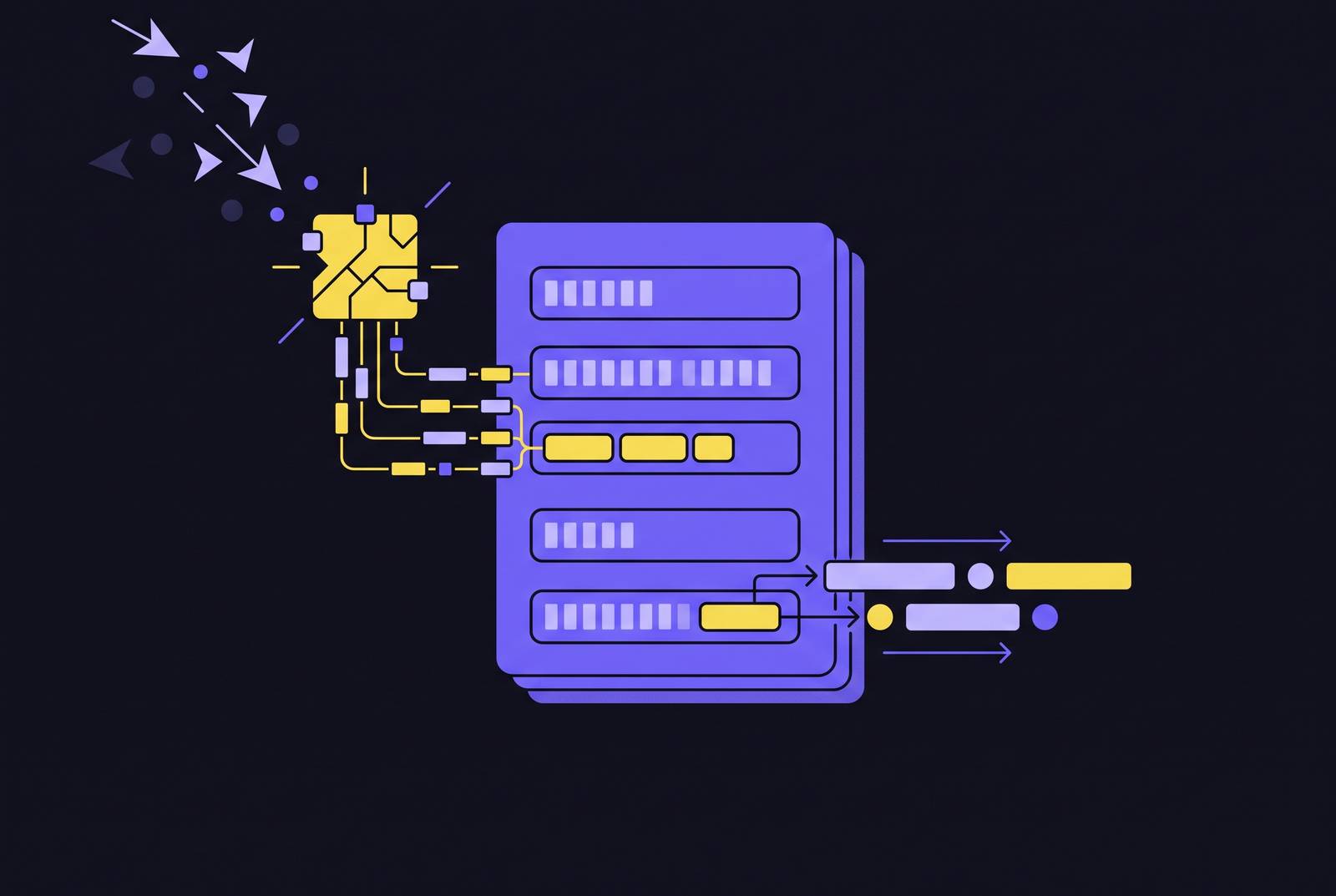
Security questionnaires were once just paperwork. Now they determine if a contract closes this month or slips to the following one, and the AI tools made for them work like this: draw from its own verified documents, write a response, score its confidence, then pass anything shaky to a human before a buyer sees it. Retrieval, not invention, is what makes these systems work. Measure any tool like this by that test before anything else: a real platform sticks to it, and a novelty does not.
Third-party risk programs now reach almost every vendor partnership, not only the essential ones, and the typical questionnaire has edged up to roughly 100 questions, with AI governance and model overs… Third-party risk programs now reach nearly every vendor relationship, not only the key ones, and the average questionnaire has grown to 100 questions, extending into AI governance and model oversight in ways they never did before. Those compliance checklists keep changing, and they always arrive at the worst moment. A questionnaire usually lands as momentum is accelerating, with infosec, lawyers, and reps all scrambling for the same scarce time together.
The state of security questionnaire automation in 2026
Dataintelo pegs Security Questionnaire Assistant worldwide at $2.1 billion for 2025, rising to $6.8 billion in 2034, with a 13.9% compound CAGR. It belongs to the broader security automation space, pegged by Straits Research at $9.74 billion for 2025 and projected to hit $29.73 billion in 2034, a 13.2% CAGR. Different analyst firms define "AI in cybersecurity" differently, so treat any single figure as an estimate tied to its own methodology, not a settled fact.
Regulated industries have been adopting this ahead of the rest of tech, and procurement now asks vendors for answers with more speed and steadiness than human checks allowed.
How the automation workflow turns a questionnaire into something reviewable
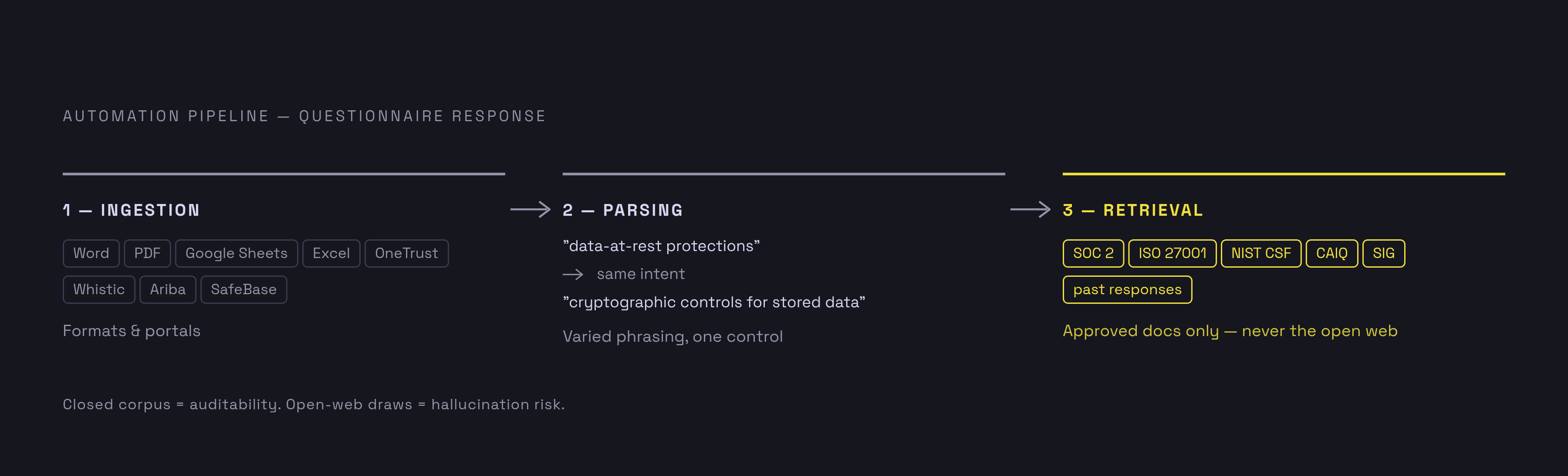
The process has three parts, and each solves its own issue.
Ingestion starts the process. A platform needs to handle whatever format the buyer uses, and buyers don't stick to one. That can be Word documents, PDFs, Google Sheets, multi-tab Excel files, or questions sent through a vendor portal, including OneTrust, Whistic, Ariba, and SafeBase. A few options cover the portal case through a browser add-on or a built-in portal agent that pulls the questions straight from the page, rather than requiring an export step.
Parsing follows, and it's the point where the AI proves its worth. It has to understand intent, not just spot a keyword. Ten buyers can ask about the same encryption-at-rest control ten different ways: one wants "data-at-rest protections," another wants "cryptographic controls for stored data," and a system that can't recognize these as the same question treats them as ten separate research tasks instead of one answer reused ten times.
Retrieval steps in at the end, and that's what decides if the tool is any good. A real tool looks only at accepted company material: rules, reports for SOC 2, evidence for ISO 27001, old questionnaire responses, audit files. It stays off the public web and never draws on whatever the model soaked up in general training. When a tool answers using open internet results or the model's generalized "knowledge", it's producing nothing but a confident guess dressed to look certain. That tool puts out a confident guess dressed as proof, and buyers can't spot the gap before harm hits.
The knowledge base: why the quality of what goes in determines the quality of what comes out
If the knowledge base is skimpy, outdated, or bad, incorrect answers come out regardless of how carefully everything else was made. A model fed poor source material never stops to double-check what it's saying. It delivers bad answers with complete confidence, which beats a hedged and hesitant reply from a person, since moving without accuracy only gets the error to the buyer earlier.
The set is clear: up-to-date security rules, valid proof of SOC 2, ISO 27001, NIST CSF, CAIQ, and SIG status, accepted questionnaire answers, and files tied to each requirement. Mapping is what makes it scale. A platform that covers CAIQ, SIG, NIST CSF, and ISO 27001 can reuse one verified response in many questionnaires, since it maps to the requirement, not the wording used.
Freshness is what no one enjoys and everyone requires. Policies get rewritten, certifications lapse or renew, and controls shift after an audit. A knowledge base that’s right in January can be off by June if nobody’s assigned to maintain it. It's routine care, not a one-time build you finish and leave behind, and skipping it leads the system to confidently give answers that no longer hold.
How hallucination risk affects security accuracy in AI
A made-up response on a security questionnaire hurts more than leaving one blank. An invented detail about data protection or incident reporting gives a prospect the wrong picture of the company's security, opens the door to legal trouble, and can fall apart under review if someone checks it. Skipping one just takes longer. A wrong answer can lose trust, and even the deal.
RAG, or Retrieval-Augmented Generation, is the architectural answer. RAG makes every response from documents pulled out of the approved knowledge base, so it isn't relying on the general training weights of the model. Hallucinations usually stem from reliance on those general training weights. The model's job shifts from "recall an answer" to "summarize what this verified document says," a narrower task and a far more reliable one.
Benchmarks offer a rough idea of how general-purpose systems perform on factual accuracy. Bridewell reports GPT-4o achieved hallucination rates of 1.5% on standardized assessments, while Claude 3.5 Sonnet scored 4.6% across standardized factual assessments, keeping both below 5%. Those figures reflect general factual work, not accuracy for security questionnaires, so read them as background for this scenario. Tribble reports accuracy above 94% on fresh security questions in ISO 27001 and SOC 2 contexts, a platform-specific result separate from the general benchmarks instead of folding into them.
How top tools vary in design and purpose
Vendors in this space work on different things, and the best match turns on who at the organization really owns questionnaire workflow, not whose menu of options runs longest.
AI-native response platforms use internal knowledge for grounded drafting, attach confidence checks, and handle routing toward the right subject matter experts. They work best for busy groups. Response management suites handle RFP tasks and broader content programs, but they only succeed if a person is named to curate the main library. GRC-embedded platforms base answers on a compliance program that's continuously monitored, which works when the response is owned by compliance instead of the sales engineering team. Portal-deflection and Trust-center systems work another lever: without automating responses, buyers self-serve answers directly, lowering inbound traffic, not speeding what still reaches the inbox. Combining automated drafting with expert human verification carries a higher price tag but improves assurance, a tradeoff that suits regulated industries and poorly fits a ten-person startup tackling its initial SOC 2 questionnaire.
AutoRFP is strongest at high-volume automation. Its Portal Agent responds within OneTrust, Whistic, SafeBase, and Ariba, and it handles Excel sheets with several tabs plus Word docs and PDFs exactly as the client provided them. Each response includes a Trust Score, plus the platform blocks made-up content: when its knowledge base can't back a reply, a human takes over rather than guessing. It hasn't been around as long as the established response management suites that have been around for decades, so buyers lack the operating history to test what the architecture's promising.
Vanta charts a distinct course, and for the appropriate buyer, it emerges as the superior option. It generates questionnaire responses from compliance records and continuously monitored security controls already on its platform, so it fits better when the GRC group owns the answers rather than sales or a response unit, and those answers must connect to an active compliance program over a fixed document store. Vanta holds a 4.6 score on G2's 5-point scale.
What it takes: readiness, workflows, and documentation
A license and a folder won't make it happen. Getting it running takes centralized documentation, a vetted library of answers, a platform that matches the team's real workflow, and a clear way to send anything the AI can't handle confidently to subject matter experts.
Before any document is uploaded, someone should audit what's already there: check for gaps, outdated policies, and missing certifications. Teams often go wrong by uploading indiscriminately, assuming extra source material produces stronger answers. Unapproved drafts and superseded versions of current policies, alongside expired certification documents sitting next to current material, get pulled into answers as confidently as anything else, and outdated material ends up treated just like current material, producing unreliable answers. Unapproved drafts, expired certification documents sitting next to superseded policy versions and current material all get pulled into answers with equal confidence as anything else, since the tool can't spot which is which until someone cleans it up.
The SME workflow should be part of the setup from day one, not bolted on later; it decides whether everything works when time is tight. Even with auto-fill at 80-95%, the remaining questions are usually the most difficult: new scenarios, odd situations, ones that touch what the knowledge base still needs to cover. Routing them to the proper expert quickly is what separates a finished questionnaire from a late one.