CCM Coverage Gaps Left by Point-in-Time Audits
Continuous monitoring closes the gaps periodic audits leave unguarded.
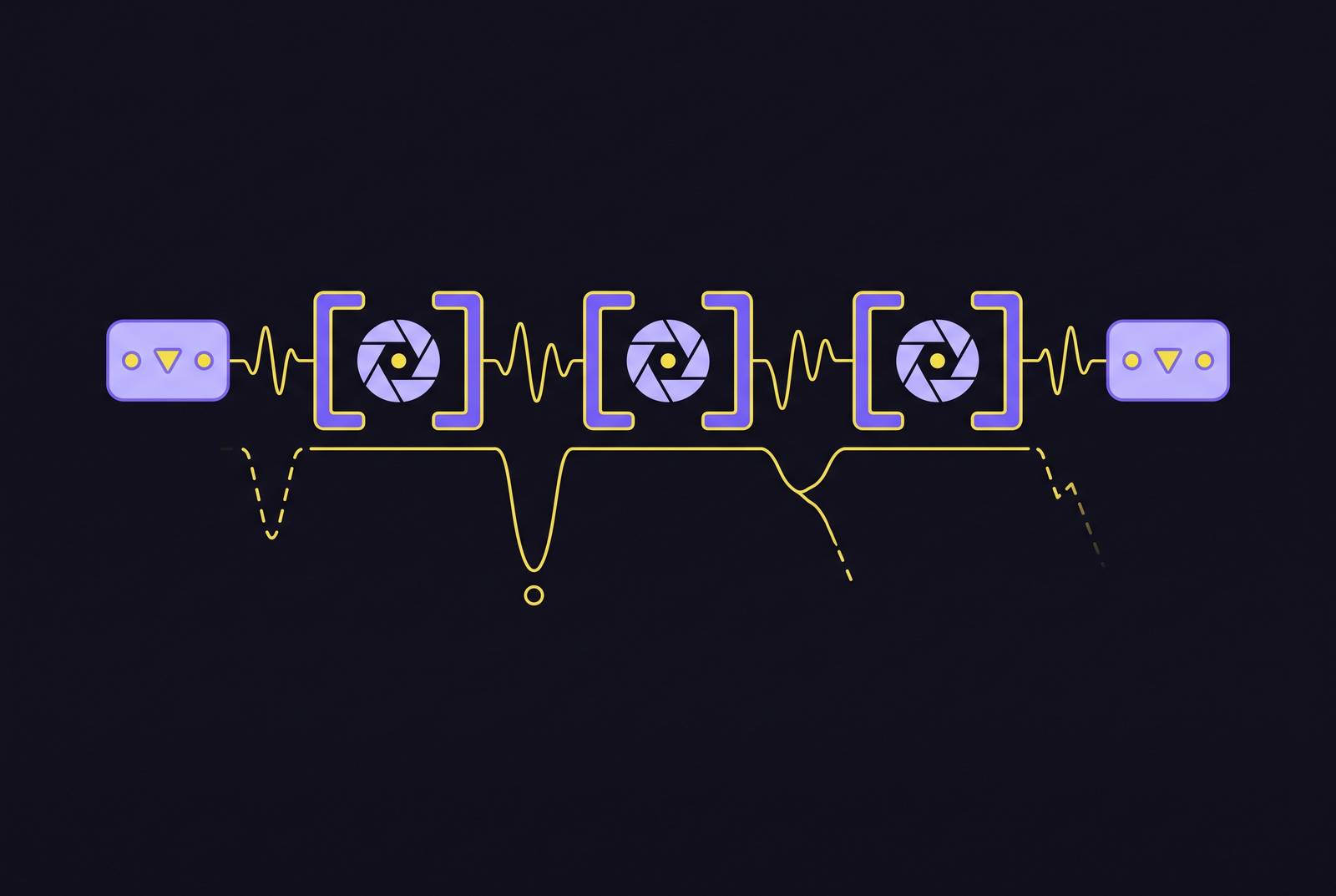
Most organizations still see compliance as a snapshot: one tidy view of the control environment on audit day. It should run like a security camera instead. A traditional audit only proves the controls passed on the day of the check, and it tells you nothing about the days after, which is when things actually break. Annual or quarterly review cycles leave a structural blind spot between assessments, and continuous controls monitoring (CCM) is built to close it. Next, we cover how that gap forms, what it costs, and what replaces it once it's running.
The specific failure modes that open up between audit cycles
Configuration drift happens silently. Permissions end up wider than needed during a deployment, logging gets switched off to fix a problem and never switched back on, backups lapse unnoticed, and undocumented policy exceptions keep stacking up. Configuration drift often happens without malice, lingering until the next review cycle checks the right spot.
Access control erodes just as predictably, only more gradually and across a wider group of people. Someone changes jobs and keeps their old access. A contractor's account should've been shut down months ago and wasn't. A service account gains more access than it was meant to have, one grant at a time, because nobody set up an automated check on it. None of it surfaces between reviews, simply because nothing monitors things in the gaps.
Vendors make the problem worse. Vendors are given access, projects end, and that access isn't removed. According to a Hyperproof survey, 64% of organizations said a third-party data breach hurt them. That's hardly unusual. Most compliance programs were simply never built to catch a failure this routine.
Evidence collection is the most avoidable weak point in the whole chain. Manual evidence gathering relies on hand-collected screenshots, log exports, and configuration reviews, and Manual evidence gathering can be inconsistent, making it more likely something is missed. Regulations add to the problem: DORA and SEC cyber rules now demand incident reports in hours or business days, while some regulations still rely on periodic reviews. A quarterly audit trail can't satisfy a regulation demanding answers by Tuesday.
When deadlines loom, teams can slip into "pencil whipping", a term from Hyperproof's research (cited by CyberSierra) for ticking boxes just to finish the list instead of truly assessing risk. Organizations running SOC 2, ISO 27001, HIPAA, PCI DSS, and GDPR together don't get a single blind spot. They end up with overlapping blind spots, because every framework’s yearly snapshot misses something a little different from the last one.
What the compliance gap costs in time and organizational attention
Getting ready for an audit usually becomes a panic, and you can see it coming every time. In the weeks before a review, teams rush to gather evidence, and CyberSierra's reporting notes that this rush often uncovers problems that had gone undetected for months. The audit doesn't cause the failure. It's simply when a person actually gets around to looking.
And then you have the actual report. Internal audit templates research cited by CyberSierra suggests a 30-page audit document, packed with findings and caveats, loses an executive audience somewhere around page three. Findings nobody reads don't drive action, no matter how accurate they are.
A fatigue loop deserves plain words: the drain from the last audit runs right into getting ready for the next. Teams often lack bandwidth for the strategic risk thinking that compliance work is meant to enable.
The metric that shows what's truly on the line is mean time to detect. A firewall rule changes, an admin account gets too much access, a logging service stops reporting quietly: DigitalXForce notes that without continuous validation, any of these can go unnoticed for weeks. CCM collapses that detection window down to something close to instant. By design, periodic review leaves that window open, and the design itself, not one missed control, is what's really wrong.
Boards, regulators, insurers, and customers want live assurance, not an outdated certificate. DigitalXForce's research describes this as a growing gap: stakeholders' expectations keep rising while many organizations still rely on periodic audits, annual risk assessments, and manual evidence gathering. You can already see that gap in cyber insurance. Some policies now require real-time posture data, and DigitalXForce warns that without it, a claim can be denied or a coverage category excluded at the worst possible moment.
What continuous controls monitoring actually does differently
At its heart, CCM is automation that keeps verifying controls are working as intended, all the time, not just at set checkpoints. CCM is described as automation that validates control effectiveness continuously, rather than relying on a person confirming it once and moving on.
The practical difference explains it all. Scytale's comparison says CCM plugs straight into the systems and evidence it tracks, tests controls against set rules, and sends an alert as soon as something changes instead of holding out for the next scheduled check. Detection shifts from calendar-based to event-based. Put simply, that is the whole change.
Per DigitalXForce's breakdown, what's actually watched covers identity and access drift, cloud and on-prem misconfigurations, broken endpoint and network policies, application vulnerabilities, and ongoing framework coverage mapping. Posture changes from reactive to proactive, and audit-readiness stops being a scramble. It just happens naturally as the company does its normal work.
Evidence collection shifts accordingly: Manual screenshots and log exports are replaced by an automated, continuously updated digital trail. And since one monitored control can often cover SOC 2, ISO 27001, HIPAA, PCI DSS, and GDPR at once, the redundant work of keeping five separate audit trails for five overlapping frameworks begins to fade.
One line has to be drawn hard, since it's blurred all the time: CCM isn't the same as general continuous monitoring in the security operations sense. Scytale makes the difference clear. CCM belongs to governance, risk, and compliance (GRC) work: it checks if internal controls still hold up, rather than scanning network or infrastructure telemetry for odd behavior. Mixing them up is how companies wind up upgrading a security monitoring tool when they actually needed a GRC tool.
The Cloud Controls Matrix audit and assurance domain as a practical framework for CCM
The Cloud Controls Matrix (CCM) from the Cloud Security Alliance anchors this discussion in something concrete. Published February 4, 2025, it sets out 197 control objectives across 17 domains, spanning cloud security end to end.
Audit and Assurance (A&A) is the first domain, basically the framework's take on organizing audits. It splits into six control specifications.
Audit and Assurance Policy and Procedures tells organizations to create, record, approve, share, use, assess, and keep up their audit policies, reviewing and updating them at least annually. Independent Assessments requires yearly audits carried out by an assessor with no role in the original implementation. Risk-Based Planning Assessment requires closer review of higher risks than medium or low ones, so an audit’s scope isn’t vague or spread evenly without regard to actual exposure.
Requirements Compliance means checking that every applicable regulation, contract, and statutory obligation lines up, mapping things like GDPR requirements straight onto internal policies and cloud security controls. The Audit Management Process covers everything from planning, risk analysis, and control checks to conclusions, fix schedules, reports, and reviewing past evidence. Remediation demands a risk-based corrective action plan and root cause analysis for each identified deficiency, since skipping root cause work means the same failure returns next quarter.
The thing to dwell on: the remediation and risk-based planning logic CCM automates already sits inside CSA's own framework. The A&A domain anticipates the coverage gap. It still relies on someone manually booking the next review, which is exactly what CCM removes. Per CSA, CCM controls work differently for cloud service providers and cloud service customers, and figuring out who owns what stops blind spots from forming in shared-responsibility setups.
How long control failures go undetected without CCM, and what that window enables
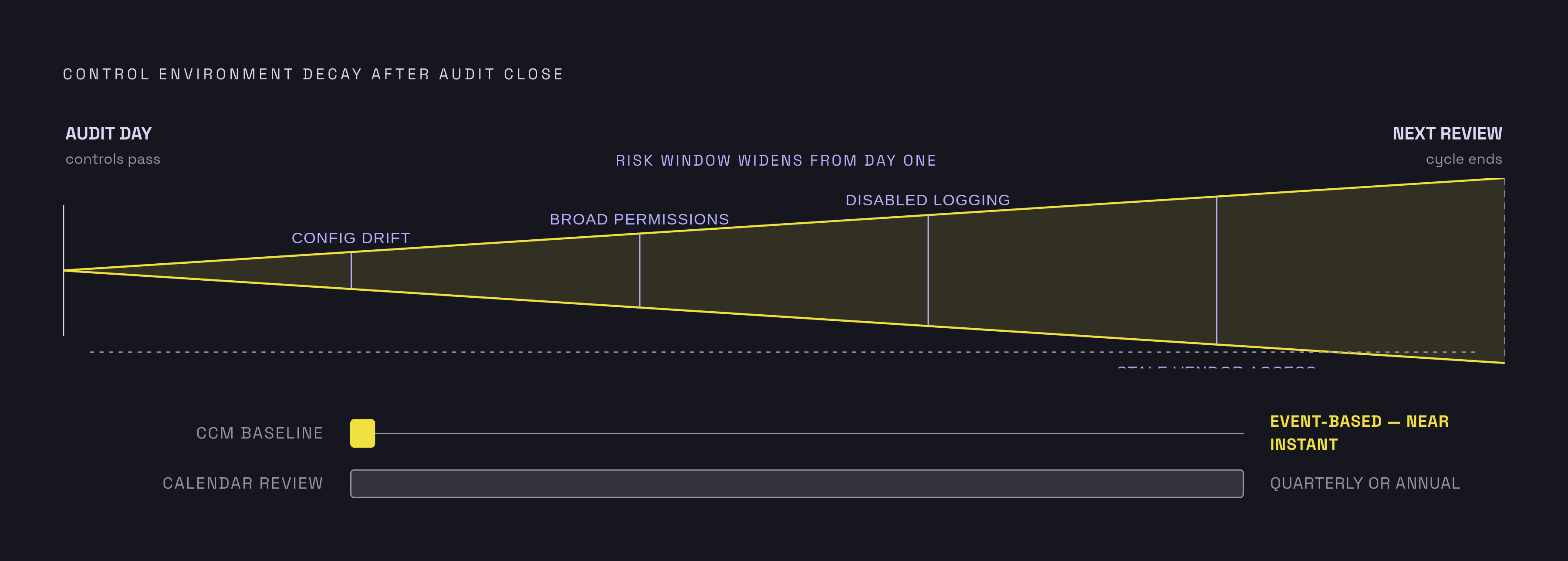
Simply put: a control that cleared its check last week might be failing right now, and DigitalXForce calls that a risk gap that widens instead of staying the same size. The gap doesn't wait months after an audit closes to appear. It starts the moment the audit ends, since The certified state begins decaying from day one of the new cycle.
DigitalXForce describes a realistic failure chain that makes the risk clear: a firewall rule changes, an admin account gains too much access, an encryption control is turned off, a logging service quietly stops reporting. Any of these can slip by for weeks if you don't have CCM. Configuration drift, overly broad permissions, disabled logging, expired backups, undocumented exceptions, and stale vendor access can each sit unnoticed through a full quarterly or annual cycle.
Attackers want exactly that window, yet most compliance discussions never touch this part. A misconfiguration left open for weeks isn’t just a paperwork problem. It's an open door for weeks. The real structural flaw isn't a single misconfiguration, it's that attackers move faster than audits do.
Regulatory deadlines make the problem worse. Under the SEC Cybersecurity Disclosure Rules, public companies must disclose material incidents and prove they maintain an ongoing risk management program, per DigitalXForce. A months-old unnoticed gap is much harder to defend to a regulator than one found and fixed within hours.
What organizations gain in audit-readiness and operational efficiency when CCM is in place
Once CCM is in place, audit-readiness shifts from a periodic event to a constant state. That's the idea, in a nutshell. Evidence stays fresh since collection happens on its own, and DigitalXForce and Scytale both land on the same practical outcome: teams quit losing weeks piecing together what a control looked like three months back.
Automated evidence collection does away with screenshots, log exports, and spreadsheets sent over email, removing much of the inconsistency and simple human error of manual work, per DigitalXForce. Multi-framework mapping lets one monitored control cover SOC 2, ISO 27001, NIST, and PCI requirements together, so Scytale says you skip the separate manual effort for each.
Remediation tracking adds a layer that matters more than it sounds like it should. DigitalXForce says CCM tools log past fixes and approved exceptions, then build reports auditors can trace completely. Auditors can view how a fix unfolded over time, not just a snapshot of where things stand now.
People overlook the extra time you get back. CyberSierra-cited Hyperproof research found that automating repeat checks and evidence collection frees compliance and internal audit teams to focus on strategic risk work, not checklists. Reports get better as well: CyberSierra's internal audit templates research shows leaders receive a one-page summary and a live dashboard of their current standing, replacing the 30-page files no one reads and outdated snapshots from past cycles. DigitalXForce notes that, for organizations handling DORA, HIPAA, PCI-DSS v4.0, CPRA, and SEC requirements at once, CCM can auto-generate attestation reports and insurer-ready risk data from current evidence, not evidence rebuilt later.
How to begin implementing CCM without treating it as an all-or-nothing replacement
Scrapping your current audit process to start over is a mistake, and it's the one most organizations make right away. There's no such requirement in CCM. CyberSierra's six-step framing adds it on top of an existing GRC program, beginning with the riskiest controls instead of monitoring everything at once.
CyberSierra says a few things must come first: basic policies and procedures must already exist, the risk scope must be clearly defined, and regulatory requirements must be mapped to actual controls. CCM makes an organized program stronger. It won't replace having one, and organizations that skip this step just automate chaos rather than fix it.
Rank work by risk the way CSA's own A&A domain already does. Continuous validation should come first for identity and access, encryption, and logging, before medium- or low-risk controls get the same treatment. The three lines of defense model still applies. Auditors, as the third line, still carry out point-in-time reviews. CCM runs in the first and second lines, giving the ongoing assurance internal audit later checks against. The structure stays the same. The monitoring rhythm beneath it does.
Getting compliance checks coordinated across roles and teams, plus the simple logistics of assigning and tracking ownership, ranks among the most frequently mentioned headaches in getting this right, per discussions in Reddit's NIST Controls community cited by CyberSierra. Hooking things together stops this from just adding more noise. Per DigitalXForce, CCM tools linked to SIEMs and ticketing apps like Jira or ServiceNow can convert an alert directly into a tracked fix job, so it stays useful rather than getting lost in alert fatigue.
Per Scytale's guidance, anyone sizing up a platform should run a short checklist: automated testing across control types, mapping across frameworks, centralized visibility into control status, and real GRC support behind it. Don't pick a tool that just gives you another screen to watch instead of cutting the team's manual work. That's more than a small missing feature. That is the line between the tool doing its job and the team doing the tool's job for it.
What CCM really changes is who's responsible for risk, and companies usually don't expect that at the start. CyberSierra describes it as shifting accountability from a central audit team to the business units that run the monitored processes day to day. Compliance becomes part of the daily workings of the operation rather than a yearly event a team undergoes.
Sources
- Why Continuous Controls Monitoring is a Must-Have in 2025
- What is Continuous Control Monitoring (CCM)? And How do I start?
- Implementing CCM: Assurance & Audit Controls | CSA
- Continuous Controls Monitoring (CCM): What You Need to Know | Scytale
- Internal Audit Report Templates for Continuous Controls Monitoring