Reducing Evidence Collection Burden With API-Based Integrations
API integrations automate AI visibility tracking across multiple clients at scale.
A brand's standing gets set in a chatbot exchange, well before a customer reaches a client's website. That reality rewrites the work for any agency offering AI visibility, because ChatGPT has no rankings list, Perplexity has no scoreboard, and no screenshot can call it evidence. Recent data shows a large share of B2B software purchasers now turn to chatbots over Google for queries, and some changed vendors mid-decision based on chatbot responses. An agency unable to show a client's position in these channels has no meaningful reporting to offer.
What agencies must measure, and why one number falls short
Collapsing AI visibility into a single figure is the quickest path to misreading it, and plenty of dashboards still make that mistake. In Martinez's 2026 survey of 45 papers, GEO visibility becomes a pipeline made up of clear steps: search activation, then crawling and indexing, retrieval, reranking, citation, prominence, absorption of facts, fidelity, plus downstream user actions. A company might pass one step and stall at another. Flattening nine separate points of failure into a single "visibility score" hides exactly the information a client needs.
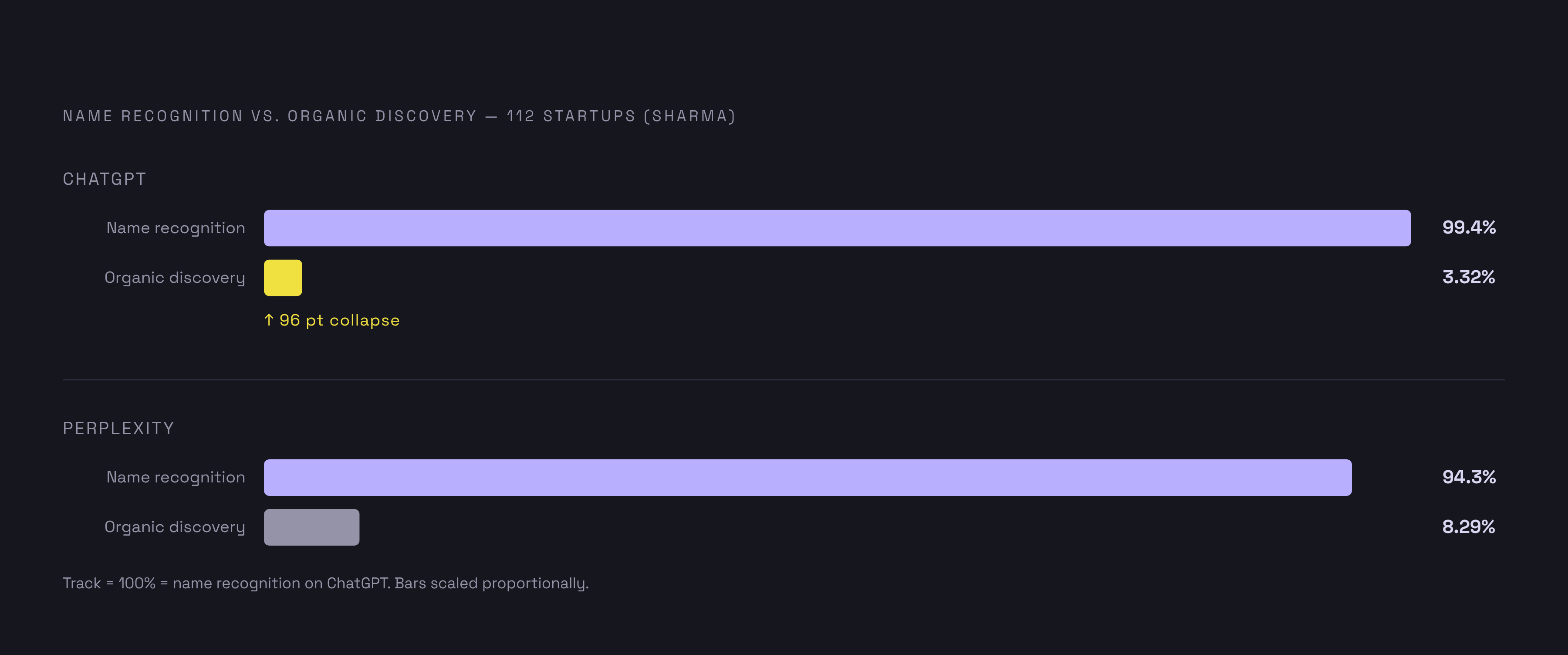
Sharma's look at 112 startups turns the gap into a hard number, and it might be the most helpful piece of data an agency could show a client. When named directly, ChatGPT identified 99.4% of items, yet surfaced those same items in only 3.32% organic discovery queries, queries where the user named no company. Perplexity exhibited the identical trend at another magnitude: name recognition of 94.3% plummeted to 8.29% in organic discovery. Being indexed doesn't mean being suggested. That gap is the ballgame: a company can appear "visible" during a managed trial while remaining hidden when a customer is ready to buy.
To get the full view of any single client takes evidence from citations off authoritative domains, credibility markers such as awards, press mentions, and a Wikipedia page, signs of content quality, and topical standing developed over time. Tracking has to cover ChatGPT, Perplexity, Gemini, Google AI Overviews plus Google AI Mode, while the platforms keep data apart and work differently. In June 2026, Google launched dedicated Search Generative AI performance reports in Search Console, offering web managers official data on AI-surface results. It's real progress. That's just one stream among the five, looking at a single client in a portfolio of maybe 50.
The real operational cost of doing this by hand across a client portfolio
On average, a comprehensive SEO audit and implementation can take 2–6 weeks for each account, involving manual data sorting and reconciliation. AI visibility stacks directly onto that effort, not next to it.
Fragmentation comes with its own price tag. Agencies using fragmented systems may spend an extra $2,000 per month on manual data reconciliation, limiting time for analysis. Some agencies have used AI-assisted reporting for patching the gap, but NP Digital says reporting and analytics sits among the worst AI jobs, with 34.2% daily mistakes, while over 70% of marketers take one to five work hours fact-checking what AI made. Adding an AI generator onto a broken data pipeline still leaves the pipeline broken. It launders mistakes more quickly and gives them to a client in a nicer font.
Then comes the barrier nearly every expanding agency faces. Infrastructure designed for a small client base often struggles to scale as agencies grow, not due to server capacity alone. It fails because each client asks for their own KPI list, reporting cadence, and anomaly limit, while a manual setup can't bend. Headcount becomes the only lever, a poor match for a problem about data plumbing.
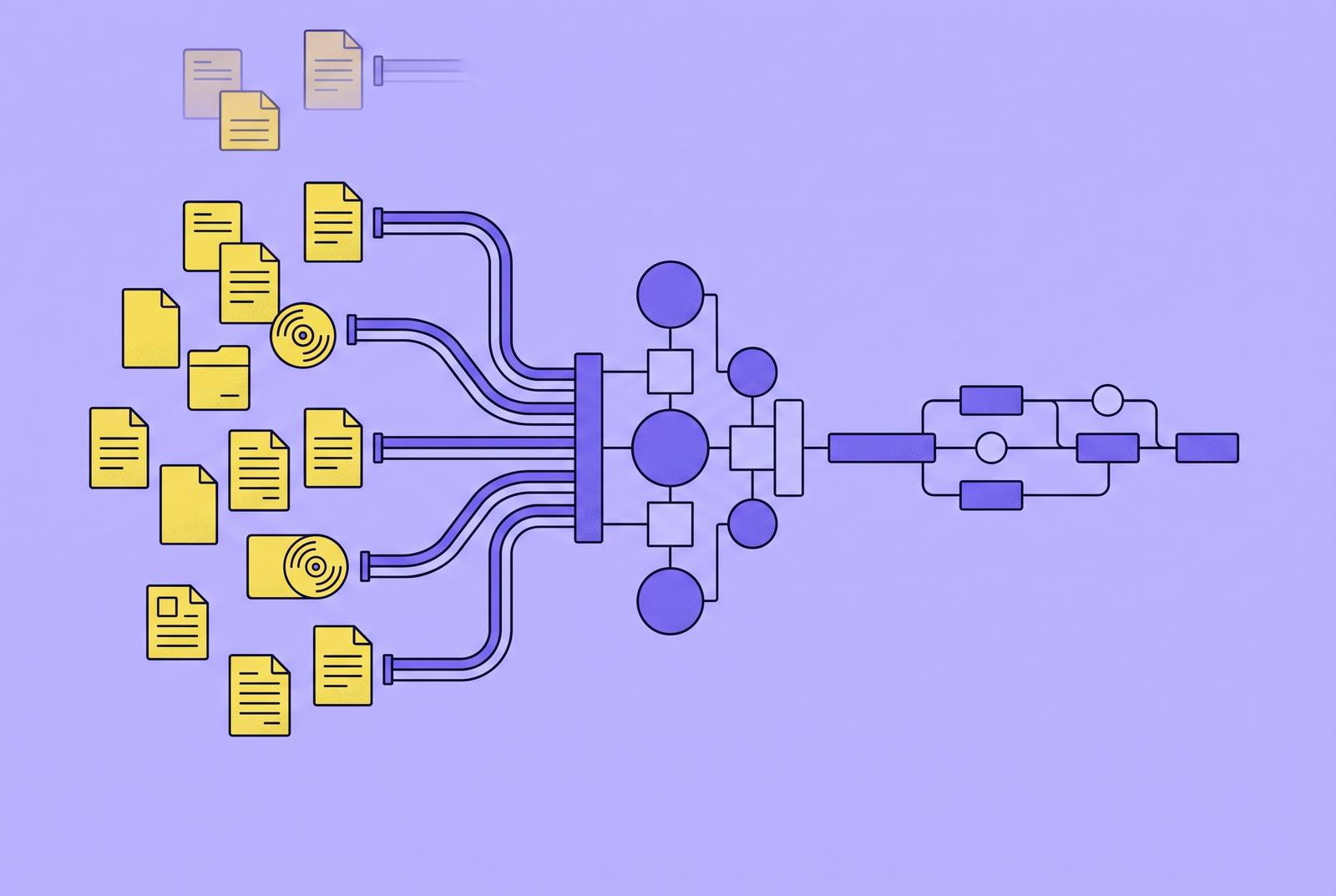
In practice, staff capture bot answers one by one, record company references manually in a sheet, pull customer files separately from disconnected systems, then redo much of it after a service alters its results with no notice. At the portfolio level, the agency's top staff waste their week putting data together rather than the counsel and analysis work retainers fund.
Connections that automatically gather info instead of hand-done processes
In 2025, 82% of organizations adopted some form of API-first strategy. It's baseline infrastructure now, the same as a CRM or mail platform, no longer a leading-edge move.
Wiring evidence collection via APIs changes how the job gets done. Static CSV files turn into real-time queries. Occasional point-in-time checks turn into always-on tracking. Logging into five platform dashboards turns into a single window covering all clients. Documents a human once assembled under time pressure turn into deliverables that generate automatically when due.
One core split tells if a tool captures the AI output a user sees, and it should guide what an agency buys. Browser automation tools pick up what's actually shown on the screen for someone using it. Tools using just a raw API can skip what the engine shows dynamically, because these platforms often give an API call a different answer than the person typing a question sees. A bad setup leaves every downstream output as a stand-in, not the real thing.
The most consequential development recently has been Model Context Protocol, launched by platforms like Ahrefs and Semrush in 2025–2026. MCP lets an AI agent query SEO data through plain language instead of custom code: a strategist types "find all high-impression pages with declining click-through rates over the last 90 days" and gets an answer without writing a script to fetch it. A few tools go beyond this, piping current stats from Google Search Console plus GA4 data directly to AI clients such as Claude or Cursor, making exporting data feel like just asking.
For client-facing deliverables, an agency-grade API should offer white-label output, dashboards with every client's data walled apart, API support for downstream custom integrations, plus benchmarking covering the full portfolio at once. Being fast helps, but that's not the biggest payoff. The real payoff is when evidence builds up automatically, much like an audit trail builds up, not pulled together in a last-minute rush.
API automation's real-world impact on time and spending
Agencies using API automation say they've shaved 40 to 60% off manual data collection and their reporting time. A team with over 20 clients gets 20 to 30 hours per month for planning, not spreadsheet work. According to HubSpot's Agency Survey, reporting automation gives back 6 hours per client each month, and stacked across ten clients that turns into steady, ongoing room to breathe rather than a single windfall.
The money argument works the same way as the time one. Once the tools are truly connected, agency leaders can recover nearly all of that monthly $2,000 spent on manual reconciliation, providing a concrete figure to weigh against the platform's fee. What matters is the time back, since account teams freed of data work can use it for review and client counsel that earns retainer renewal.
One thing holds no matter how advanced the automation gets. Someone still has to see if the numbers are right, and a 34.2% AI miss level in report work makes the case for sending solid auto systems to skilled people, not removing them. The scaling still favors automation: fragmented manual work punishes expansion as clients pile up, whereas an API-connected setup pushes the marginal effort of onboarding each new client close to nothing for data-collection, even if someone still has to interpret the output.
GEO tracking tool options and what matters in a platform built for agencies
Platform coverage is a must. If an AEO tracking tool is any good in 2026, it tracks ChatGPT, Perplexity, Gemini, plus Google AI Overviews and Mode from Google, getting real AI responses rather than simulating them.
Once prior visibility ends, the buying checklist tightens up quickly. Start by finding out if it uses browser automation to capture what a real user experiences, or simply a raw API call. Will it store client data cleanly apart on a single multi-account dashboard? Can it create white-label files an account manager can give over without removing the brand, make an API available for custom builds, compare with a client's named alternatives, not a generic industry group, and show citation-level data, not raw mentions?
A few named platforms reveal the spread in pricing and design. SE Ranking's AI Search Add-on includes citation-level data for AI visibility tracking. Profound sits at the high end, backed by venture capital and serving Fortune 100 brands, verifying human visits through integrations with CDN providers like Cloudflare and Akamai. Profound offers enterprise-tier tracking, with pricing structured for agency and client workspaces. LLMrefs covers multiple engines with no project limits. AIclicks offers a monthly pricing plan. Semrush offers an AI Visibility product for domain tracking.
Some tools serve a distinct role aimed at the agency need instead of single-brand work, giving an agency one workspace to view each client's AI visibility across accounts, rolling up portfolio-wide analytics alongside granular per-client settings, a setup general-purpose GEO trackers rarely offer because they serve one company. Billing in these tools can flex as well, staying centralized at the agency level or split by client to fit how agencies work rather than pushing a single-brand model on a multi-client setup.
These tools cannot replace a skilled account team. Whatever the program captures won't be useful unless someone can walk a client through it.
Why agencies need more than reporting infrastructure
Automated evidence collection puts the evidence together. It won't interpret anything, and confusing those steps is why so many agencies stall after getting the tool. An account manager unable to describe how a Perplexity citation affects the pipeline of a client wastes data they already have, regardless of its accuracy.
White-label reporting is framed around design problem: prettier displays and cleaner PDFs. At its core, this is a data infrastructure issue agencies deal with, not a design one. It means normalizing data between schemas that differ, and absorbing the work whenever a platform changes the output format with no notice. An agency has to find a platform that eats the fix work internally, rather than one that paints a nicer picture over that same brittle pipeline.
This is where Sharma's study's gap between organic discovery and name recognition earns its value in a client discussion. Walking a client through a 99.4% direct-name recognition rate against a 3.32% organic discovery rate is genuinely useful. It matters only when the account team says why the gap happens, and what closes that gap. Without that, it's just a discouraging figure with no way forward. Martinez's survey finds GEO audits overlap poorly between data providers, vary a lot between runs, and keep finding gaps between what's reported and what's true. Agencies need to be clear with clients here: the evidence can't justify guaranteed deterministic results, and acting as if it can puts the account at risk when the figures shift for the first time.
A full agency offering here rests on 4 parts: data pipelines that are automated and continuous, taking over manual collection; multi-client dashboards featuring white-label output; account teams trained in AI visibility data, showing real fluency with it in a client meeting; and per-client reports linked to that brand's results, not some generic industry benchmark. Building that people piece into the offering rather than leaving it as an afterthought, with a set program to teach agency reps and account leads how to speak about AI visibility with real conviction, is what separates stronger platforms from the rest. That makes an agency the go-to voice, not a reseller pulling data from another company's dashboard, and helps hold the account after the pipeline goes live.
Agencies trading hands-on evidence gathering for API tools do more than save time. They shift into another kind of firm: away from report work toward AI visibility advising, a new offer, at another fee, with deeper client ties.