Keeping Trust Center Control Status Current After Infrastructure Changes
Stale trust centers cost sales when infrastructure changes go undocumented.
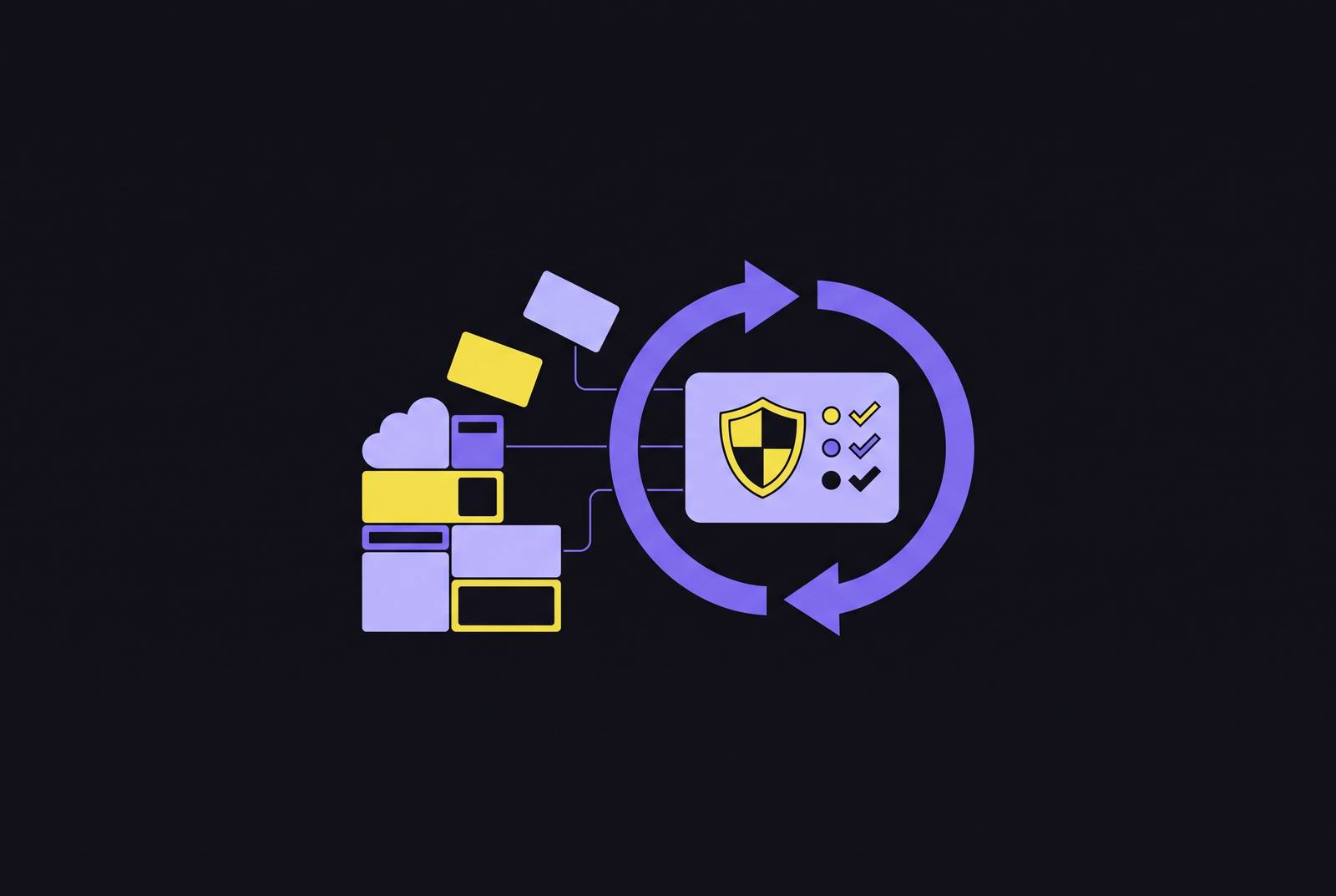
Keeping Trust Center Control Status Current After Infrastructure Changes ⟦c1⟧.
Why trust centers lose accuracy after infrastructure changes
A trust center only works if what's published matches what's actually running in production, and that's where most programs quietly fall apart, because infrastructure changes (new cloud regions, subprocessor swaps, architecture shifts, certification scope expansions) silently invalidate trust center control statuses, and closing that gap requires a deliberate, repeatable update process tied directly to change management workflows⟦c2⟧. Teams tend to treat a trust center as proof, when really it's only ever evidence, and evidence is only as good as its consistency with the vendor's current operating model⟦c3⟧. Proof implies something settled. Evidence has to be checked against reality every time something changes, and infrastructure changes constantly.
The money at stake is not abstract. Secureframe's Cybersecurity and Compliance Benchmark Report for 2026, drawn from a survey of 255 users, found that 46% of companies said a missing compliance certification delayed a sale, and 61% said achieving compliance was specifically what let them win or renew a contract⟦c4⟧. Those numbers describe a sales process where the trust center is doing real commercial work, not sitting there as a badge collection. A stale trust center doesn't just look bad, it actively slows revenue.
Infrastructure changes, new cloud regions, subprocessor swaps, architecture shifts, and certification scope expansions invalidate a published control status the moment they happen, and nothing about the change itself triggers a corresponding update⟦c2⟧. Engineering ships the change. Compliance finds out later, if at all.
Research on regulated cloud migration finds that the gap between an infrastructure change and its compliance consequences typically becomes visible six to twelve months later, usually at the first audit or the first security questionnaire that asks a pointed question⟦c5⟧. For most of that window, the trust center has been telling customers something that isn't true anymore, not through dishonesty, but through neglect of a process nobody built.
The categories of infrastructure change that invalidate trust center status
Not every infrastructure event matters equally, and this is less a checklist than a pattern to learn to recognize. Four categories break trust center accuracy, each in a different way⟦c26⟧.
Cloud migrations and repatriations sit at the top of the list. A Flexera report found that roughly one-fifth of workloads originally moved to public cloud have since been pulled back to private or on-premises environments, and more than 69% of IT leaders say they're actively considering moving at least some workloads out of public cloud⟦c6⟧. Every one of those moves changes the control boundary, and often the data residency claims sitting on the trust center right now. A repatriation can invalidate a cloud provider attestation overnight because the published claim no longer describes where the data lives⟦c6⟧. IBM's 2025 X-Force Threat Intelligence Index found that 45% of cloud-related breaches came from misconfigured storage or identity access controls, not provider-level vulnerabilities, and that pattern traces directly back to infrastructure changes handled as purely technical work with no parallel compliance tracking⟦c7⟧.
Subprocessor additions and removals are the second category, and arguably the most frequent. Many data processing agreements require vendors to notify customers when a subprocessor changes. An outdated list isn't just an embarrassment, it can be a contractual breach. These changes happen on their own schedule, independent of any major infrastructure project, so they're easy to miss if nobody's watching for them specifically.
Certificate renewals and resiliency events form a third category, and Veracode's public record offers a clean, concrete example of how this plays out ⟦c8⟧. After a third-party outage on October 20, 2025, Veracode launched a review of its systems, evaluated additional resiliency safeguards, and proactively renewed root certificates across the core systems used for internal service-to-service communication⟦c8⟧. Veracode's trust center documented this in real time through a dedicated Trust Center Updates section⟦c8⟧. Certificate validity dates become inaccurate the instant a renewal completes, and they're among the first things a sophisticated buyer checks during a security review.
Certification scope expansions and reporting period roll-overs make up the fourth category. A SOC 2 report's period end date tells a stakeholder how old the underlying evidence is, and letting that date drift without a corresponding trust center update sends its own signal, whether intended or not⟦c9⟧. SPS Commerce moved to overlapping semi-annual SOC 1 reporting specifically to give publicly traded customers, whose fiscal year-ends vary throughout the calendar year, more continuous assurance⟦c10⟧. Scope expansions, adding a new framework, a new region, a new product line, carry the same obligation. They need trust center updates.
A fifth pattern, architecture shifts that move the shared responsibility line, deserves separate attention because it changes what the trust center is even allowed to claim. In cloud environments, adopting a new managed service shifts who operates a given control: the provider takes responsibility for the underlying infrastructure while the customer has to evidence tenant-side controls, identity, data governance, monitoring, configuration, on their own. Salesforce's own trust center shows this clearly: it documents Salesforce's half of every compliance framework, but a customer handling protected health information is still expected to evidence its own configuration, encryption at rest, audit trails, session security, multi-factor authentication, separately⟦c11⟧. When an architecture shift moves a control from customer-operated to provider-operated, or the reverse, the trust center language has to move with it.
Regulatory pressure that makes stale trust center content a compliance risk, not just a credibility problem
Trust center accuracy used to be a best-practice suggestion. It has become, for vendors touching regulated markets, something closer to a legal obligation, and the shift is worth taking seriously rather than treating as compliance theater.
NIS2 requires an early warning notification within 24 hours of becoming aware of an incident, a formal notification within 72 hours, and a root-cause analysis within one month⟦c13⟧. Those timelines only make sense if the underlying trust center content is current enough to serve as a disclosure baseline in the first place⟦c13⟧.
There's a useful efficiency buried in here. Build it once, satisfy two regimes ⟦c9⟧.
None of this stays neatly inside EU borders, either ⟦c13⟧. DORA and NIS2 reach any vendor selling into the EU or supplying an EU-regulated firm, through contractual flow-down clauses that make the obligations someone else's problem to enforce⟦c15⟧. Adding the CLOUD Act, the Schrems II ruling, and the UK's Cyber Security and Resilience Bill to the mix makes a US-incorporated vendor with outdated data residency claims on its trust center a procurement risk for any regulated buyer doing due diligence⟦c16⟧. Regulators do not wait for a company's quarterly trust center review cycle. The update process has to be tied to the infrastructure change event itself, not to a calendar. DORA, applied since 17 January 2025, continues to see its supervisory expectations in governance, resilience testing, third-party exit strategies, and audit rights take shape through 2026, while ICT third-party risk rules in Articles 28–30, including subcontracting provisions, push toward real-time subprocessor transparency ⟦c12⟧. NIS2 Article 21(2)(d) on supply-chain security and DORA Articles 28–30 on ICT third-party risk management both push toward the same workflow, so the process built for GDPR subprocessor change notices does double duty across EU obligations ⟦c14⟧.
Identifying infrastructure changes that require a trust center update
Not every infrastructure change warrants a trust center update, but without a defined decision rule, someone eventually assumes a change was too small to matter, and it wasn't.
A workable rule asks whether the change touches any of a short set of things. Data residency: which cloud provider, which regions, whether customers can choose where their data sits, comes up in nearly every security review, so it has to be right. The subprocessor list: any addition, removal, or material change to a named subprocessor counts. A certification's scope, period, or status changes when a new framework is added, an audit period rolls over, a certification lapses, or a scope expands to cover a new product or region. The shared responsibility boundary: any shift in which party operates a named control. Certificate validity dates: any proactive renewal or replacement of infrastructure certificates. And published data flows or architecture descriptions that are simply no longer accurate.
That question belongs on the change request form itself, answered at the moment the change is proposed. Some of these changes need to move immediately, subprocessor additions under a DPA's contractual notice timeline, or certificate renewals forced by an incident ⟦c17⟧. Others can be batched into a scheduled review cycle, scope expansions and period roll-overs among them, but the batching cadence needs to be written down explicitly, not left as an assumption⟦c17⟧.
Cloud environments add a wrinkle that makes discrete checklists insufficient on their own. Configurations drift from a compliant baseline within days as developers deploy, and most organizations only assess that risk once, at migration kickoff, never revisiting it afterward. The trigger identification process has to account for that kind of continuous drift.
Trust center update ownership and its connection to change management
Infrastructure changes are typically owned by engineering or DevOps ⟦c18⟧. Trust center updates are typically owned by security, compliance, or marketing.
A workable ownership model closes that gap in four steps ⟦c26⟧. The change requestor flags the trust center impact directly on the change form, using the detection criteria above. A named compliance or GRC role, an individual, not a committee, reviews the flag and decides if an update is actually required⟦c19⟧. The trust center update itself belongs to whoever manages the platform, a GRC team, a security team, or a dedicated trust center owner, working against a defined service-level agreement from flag to publish⟦c20⟧. And legal or DPA review is mandatory specifically for subprocessor changes before anything goes live, because of the contractual notice obligations involved⟦c21⟧.
Subprocessor governance deserves its own mention here, because it's the category where a disconnected process causes the most damage. A trust center can close that gap by turning the whole sequence into one connected workflow: a public, always-current subprocessor list, a subscriber base of controllers and data protection officers, structured change notices, an enforced objection window, and an immutable audit trail of every notice sent and every objection raised⟦c22⟧. That's not a nice-to-have. A notification process either satisfies a contract or only looks like it does.
Architecture shifts that move the control boundary require joint sign-off, not single ownership. When a company adopts a new managed service and a control moves from customer-operated to provider-operated, both the engineering team and the compliance team need to approve the updated trust center language before it publishes. Neither side has the full picture alone. And for the changes that sit in a gray zone, ambiguous enough that nobody's sure if an update is required, there needs to be a defined escalation path: someone makes that call, and a clock governs how quickly they have to make it.
Building the repeatable update process: from change event to published content
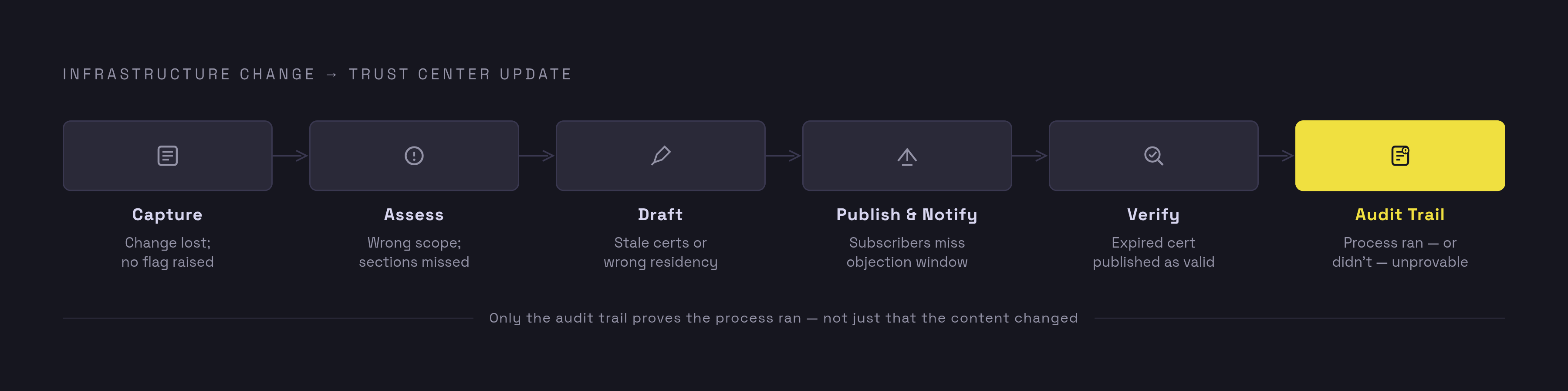
The process has seven steps, and each one exists because skipping it has a specific, identifiable failure mode attached ⟦c29⟧.
Capture comes first. The change management system records the infrastructure change along with the trust center impact flag, and that record becomes the origin point for everything that follows⟦c23⟧. Assess comes next: the named compliance owner reviews the flagged change against the decision criteria already defined, decides if it's immediate or batchable, and scopes out exactly which sections of the trust center are affected⟦c24⟧.
Draft is where the actual content gets updated, certification status and dates, the subprocessor list, data residency statements, architecture descriptions, certificate validity, all brought current⟦c25⟧. For subprocessor changes specifically, the customer notification gets drafted at the same time, not afterward⟦c25⟧.
Publish and notify pushes the content live and, for subprocessor changes, sends the structured change notice out to the subscriber list along with whatever objection window the contract requires⟦c27⟧. Verify closes the loop by confirming the published content actually matches the source of truth, checking certifications against an accreditation registry like IAF CertSearch, the global database for validating accredited ISO/IEC 27001 and other management system certificates, and confirming the published subprocessor list matches the current vendor roster⟦c28⟧. Audit trail is the final step, and it's easy to treat as an afterthought: retain a timestamped record of what changed, when, and who approved it, because that record is the evidence the process is actually operating, separate from the content itself⟦c29⟧.
Immediate-category changes need a defined SLA measured in days, not weeks⟦c30⟧. Batch-category changes need a maximum accumulation window written down explicitly, so lower-urgency updates don't quietly drift for a quarter or more. The long-term aim is connecting published evidence directly to live control sources so the portal stops drifting from reality on its own, but the seven steps above are the floor for any team that hasn't built that connection yet ⟦c29⟧.
Platform and tooling options that reduce the manual burden of staying current
The process above is designed by people, but a meaningful share of the execution can be automated, and where that automation delivers the most value depends on the platform.
Drata also launched agentic AI for vendor risk management in August 2025, and the Continuous Monitoring section of a trust page can showcase controls maintained within Drata and their current status⟦c31⟧.
Vanta automates evidence collection and monitoring across more than 35 frameworks, including SOC 2, ISO 27001, and GDPR⟦c32⟧. A major 2026 update brought a redesigned multi-workspace experience built for larger programs, a centralized Test Library with more than 1,000 infrastructure tests spanning AWS, Azure, and GCP, and native support for internal audits⟦c32⟧.
Beyond the bundled platforms, monitoring tooling addresses a narrower but real problem: automated crawlers that watch trust center pages for changes, lapsed SOC 2 badges, new certifications, status indicators that flip, and route alerts into ticketing systems like Jira within hours⟦c33⟧. That's most valuable for third-party risk management programs tracking many vendors' trust centers at once, but the same logic works in reverse, catching the moment a company's own trust center content drifts from what its compliance platform actually shows⟦c33⟧.
Salesforce's approach illustrates a different kind of granularity. The public trust site reports at the instance level and sends alerts for every product tied to an instance, whether that customer actually uses the product or not; Trust Center filters that down to only the tenants and products actually assigned to the authenticated user⟦c34⟧. It's a meaningful distinction, since noise at the instance level trains people to stop reading trust center alerts altogether.
Whatever the platform, organizations running on-premises or heavily custom control stacks get noticeably less automation coverage than cloud-native environments do. That matters most exactly when an infrastructure change involves a move back on-premises, which is precisely the scenario where trust center updates are hardest to get right and easiest to get wrong.
Sources
- Veracode Trust Center | Powered by SafeBase
- Trust Centers: How to Best Showcase Your Organization's Cybersecurity and Compliance Efforts in 2026
- SPS Commerce SPS Trust Center | Powered by SafeBase
- How Leading Companies Use Trust Center Updates — Best Practices and Examples
- Creating and Managing Trust Center Updates | Vanta Help Center
- Introducing My Trust Center: A Personalized Approach to Trust and Status - Salesforce Admins
- How to build a comprehensive Trust Center | Vanta