Automating Access Review Evidence for SOC 2 Type II
Automation bridges the gap between quarterly reviews and continuous SOC 2 compliance.
SOC 2 Type II makes access review a compliance year-round job, but most groups still treat it as the quarterly chore. Weeks get lost in that mismatch. It explains which tests auditors actually run, how spreadsheet-based reviews fail when headcount gets too high, plus where automation can and cannot help during each access lifecycle. This gap counts because a firm can sail through Type I cleanly but fall short in Type II for an identical check, just because no one showed it kept going across six months.
Reviewing Type I means asking if a safeguard was set up right on one specific date. Type II asks a tougher question: did it run as intended, working continuously, for at least three months, often six to a year? The evidence situation changes completely because of that window. A written rule shows what was planned. The timestamped record shows the rule was carried out in March, also June and September, rather than only noted once during January.
Access review controls fall under Common Criteria guidance, specifically CC6.1 to CC6.3, which address both digital and facility entry. The only required Trust Services Criterion means every SOC 2, whatever its scope, touches access review somehow. When checking these controls, Auditors want three answers: who gets access to private information, if that matches the written rules, and if the company does something about any mismatch.
Continuity is what separates an access review from a one-shot penetration exercise: a single event, then a write-up. Say you run quarterly access reviews, and auditors want proof for every quarter. Skip a single cycle and that means a failure across the period, rather than just paperwork gap. Rather than a recap drafted days before fieldwork kicks off, Evidence must document choices taken and followed up on across the entire observation window.
The costs involved make the failure modes hard to ignore. Type II audits usually cost roughly $25,000 through $75,000, some 60% above Type I, largely because wider sampling is needed during the observation period. With tooling, staff time, plus remediation work included, a 50-to-100-person SaaS business often ends up from $30,000 to $80,000 and up. And it isn't only about redoing the work when an audit comes back incomplete. It may stall big-company sales held up until the audit ends.
What auditors actually look for when they examine access review evidence
Auditors want evidence across 4 areas, but if any has vague documentation it triggers follow-up quickly. Access policies need to show who may request each item, the needed approval, and the grant duration. Approval paperwork needs to display the name of each approver and the date in a structured layout, rather than scattered email messages that must be pieced together and read later.
Deprovisioning and Provisioning logs count too: timestamped entries that say when users got access and when it ended. Evidence of periodic review needs attestation logs, reviewer notes, plus remediation items showing when they were finished. Auditors don't just verify that people glanced over access records. Auditors want proof that review resulted in real follow‑up.
Most mistakes happen when deciding what falls inside the scope. Auditors go beyond Interactive human logins to examine API keys, service accounts, IAM permissions in the cloud, contractor access, plus entitlements for third-party vendors. The Okta 2022 vendor breach, where a vendor's access led to a wider compromise, highlighted the risks of non-human and outside access routes. Any review limited to employee logins inside your primary identity provider stays structurally incomplete, even if it seems thorough.
Cadence rules shift across service levels, and missing the mark is a common finding auditors note. Admin and privileged access usually gets reviewed each month. At least quarterly review is needed for Critical systems, live infrastructure, identity services, and buyer databases. Twice-a-year review is usually enough for lower-risk systems. Role changes, departures, plus other organizational shifts call for ad-hoc reviews beyond the usual cadence, since holding off until that next scheduled cycle defeats the point.
Auditors focus most closely on remediation, since that's where plans turn into real action. Just flagging it won't cut it. Auditors want evidence showing access got revoked plus a recorded timestamp, while remediation items need someone assigned along with a target and final completion date. If the two drift again and again, scrutiny follows, and it can end up as a reported issue that triggers the follow-up audit.
How manual access review processes break down as organizations grow
Most groups plan for fewer hours than manual review actually takes, and plenty of research proves it. Hyperproof's 2025 IT Compliance Benchmark Survey shows one in two compliance workers pour 30% to 50% of their hours into repetitive, manual evidence work. When there’s no automation, groups often lose 40 to 80 hours each quarter documenting process-based controls and application-level controls, time missing from audit bills but still on a person's schedule.
Spreadsheet-driven reviews keep hitting the same Three failure modes, and you won't spot the bad one until your auditor asks about it face to face. Stale access quietly accumulates: an employee moves groups or leaves the firm, and without automated deprovisioning those permissions sit there until someone finally recalls deleting them. Reviews should spot this, yet when a review is done manually and on a quarterly basis, that access may persist across months between those cycles.
Approval records end up scattered across email and Slack threads. Once the audit comes around, such threads sit scattered in different inboxes, gone, or too hard to reconstruct fully. A screenshot from Slack isn't what auditors want. They want a structured record of who approved what and when.
The next failure involves Access duration, and good intentions usually drive it. A person gives access marked "temporary" for one task, but since revocation needs one human remembering afterward, temporary quietly turns lasting. No one meant to keep that access active for good. It just stayed open, because ending it wasn't really something anyone owned.
Scoping, though, is arguably its own failure, hidden till an auditor starts asking about some tool that never made the list. Spreadsheet-based reviews need a person to remember each in-scope tool every quarter. Long-tail SaaS apps, the graphics tool the creative team runs on, the niche platform a lone developer grabbed on a whim, keep getting skipped because they never integrate into SSO or any IAM setup. Even when reviews take place, entitlements are usually flattened into a basic has-access versus doesn't-have-access binary that doesn't show minimal privilege.
Deprovisioning failure is a common SOC 2 access review issue. When an employee moves on or changes jobs, their old access lingers. Common deficiencies: unchecked admin privileges, casual or poorly documented reviews, and slow removal after people leave. Orphaned accounts and dormant ones aren't harmless, either: they make auditors check every place those accounts reached, and that stretches the review timeline while driving up the cost.
Here, privilege creep means the same issue playing out slowly and quietly. One access grant never seems unreasonable by itself, yet stacked across months, permissions grow beyond what a role truly requires. AccessOwl quotes CloudEagle on breaches tied to too many permissions, around 60% of data breaches involve excessive permissions, helping explain why unchecked privilege creep appears in SOC 2 findings: manual reviews look at access as it stands, rather than the earlier drift behind it.
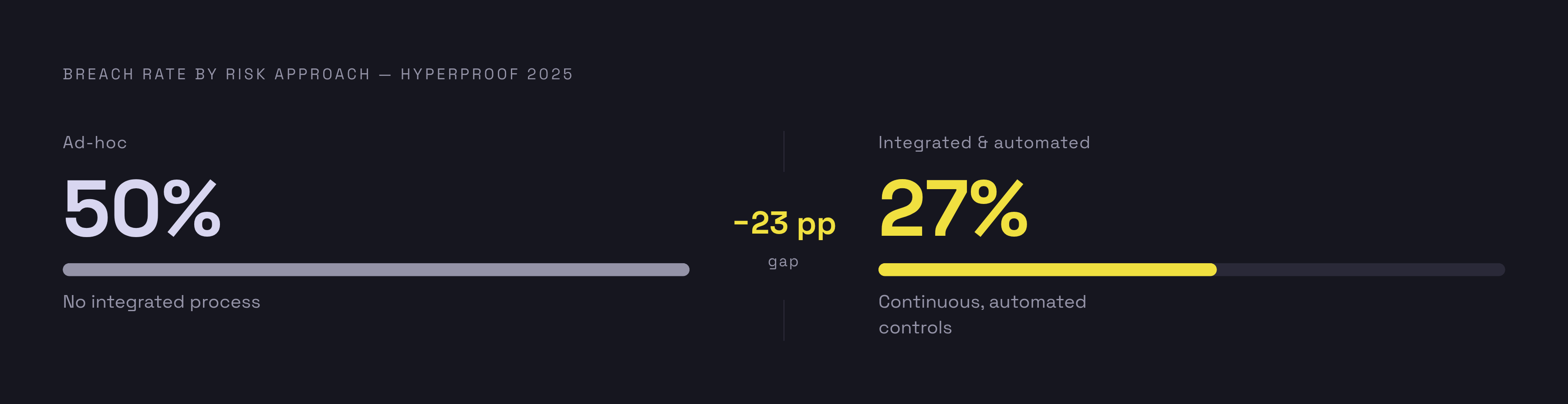
The measurable posture impact makes the best case that none of this is just paperwork. Hyperproof's benchmark numbers show that during 2025, Hyperproof's benchmark data revealed that 50% of organizations managing risk ad-hoc experienced a data breach in 2025, while organizations utilizing an integrated, automated approach had a breach rate of 27%. A gap that big can't be dismissed as random variation. That's what reactive compliance work really charges you, hitting budgets for handling breaches well before any audit flags it.
What automation actually does across the access lifecycle, and what it leaves to humans
Automation's true worth is what quietly gets replaced, not a dashboard. The audit trail no longer needs its own work. Once provisioning, deprovisioning, requests for access, and approvals all flow through one automated workflow, an audit trail is just a byproduct of normal use, not a record a compliance person has to reconstruct later. When an auditor asks about access logs, someone pulls them up. No more digging in Slack, no more rebuilding who had approved what three months later.
Automated systems record evidence across the whole lifecycle, from start to finish. When someone makes a request, the system logs the user's email plus a timestamp and which rule applies. At the approval step, the system logs who approved it, when it happened, and every step when several reviewers were involved. Provisioning logs the date access begins, the scope, and the platform touched. Access is tracked through duration plus all role changes over time. Deprovisioning captures when revocation happened, whatever triggered it, whether scheduled expiry, a role shift, or offboarding, plus proof that access was actually cut off, not merely flagged.
Fixing access on the spot is the main way a manual approach differs from an automated one. Once the reviewer marks a user and software then revokes access, the exposure window collapses to nearly zero. This is structurally unlike flagging an item for follow-up that sits in a queue two weeks. That remediation is saved in an audit trail as timestamped, resolved, not a loose task a person must track ahead of fieldwork.
Continuous monitoring also changes what evidence looks like. Some automated platforms perform over 30 checks on access posture in various domains every day or hourly, spotting drift between review cycles and not just once a quarter. The observation window is why this is critical: gathering evidence across the full period gives a Type II file, not one retroactively assembled right before an auditor arrives.
This doesn't close the gap fully, and a vendor promising the reverse is talking up more than the tooling actually delivers. GRC platforms often handle infrastructure controls: AWS configurations, employee onboarding, document versioning. What they tend to leave uncovered is roughly a fifth of the picture, the application-level and process-based controls where human judgment and business context still matter, and where long-tail SaaS tools without API or SSO integration still need someone to scope them by hand. Automation shrinks the work. It won't fully erase it.
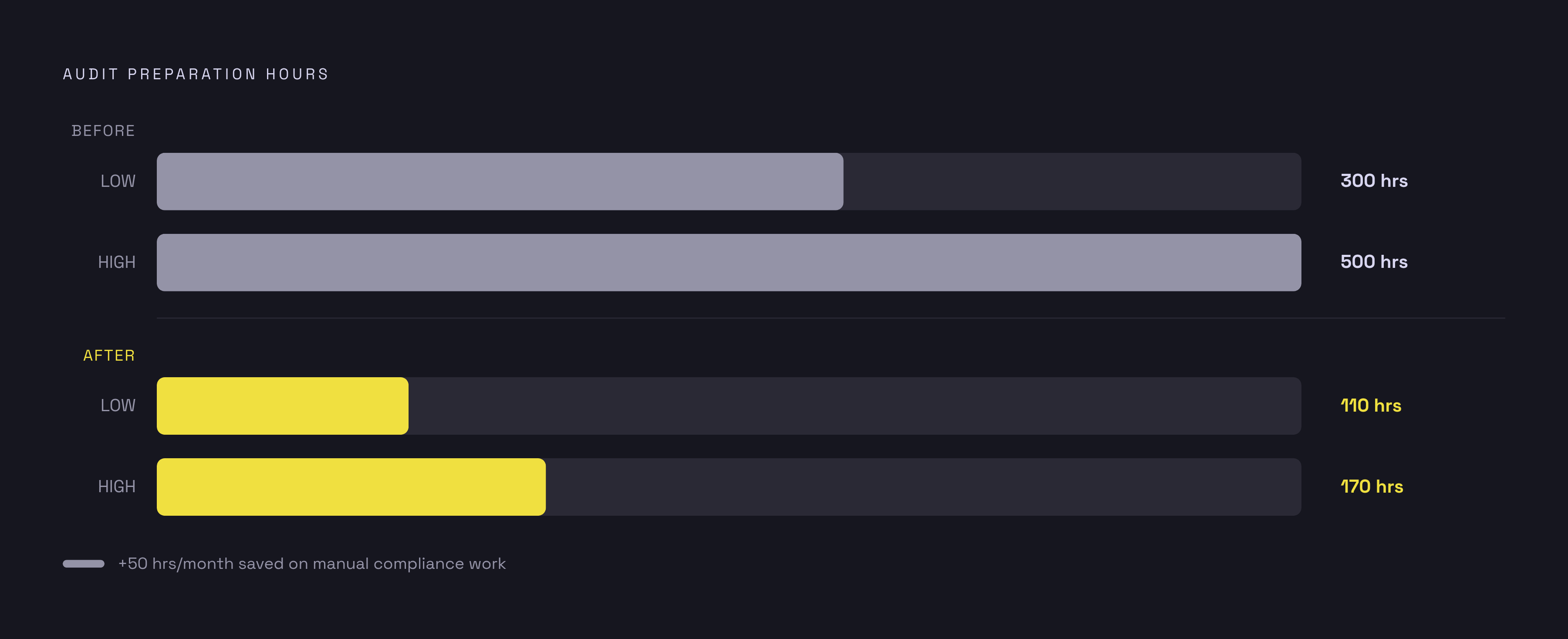
You still cut hours significantly in those areas. Audit prep can drop from 300–500 hours down to around 110–170 hours, roughly, once AI-powered platforms are in place. Users can save roughly 50 hours a month on manual compliance work. That time gets redirected to protecting systems rather than gathering evidence.
The platforms handling automated access review evidence in 2025 and 2026
Drata does automated evidence collection and continuous monitoring, built around cloud-native systems. Drata integrates into AWS, Azure, plus GCP, automatically gathering configuration compliance details, access logs, and findings to help organizations where heaviest evidence work sits within infrastructure controls.
Vanta does ongoing compliance tracking through pre-built connections with widely used SaaS tools, and startups handling their initial SOC 2 audit rely on it. Figures from Vanta's published data show teams cut roughly 50 hours of manual compliance work each month.
Thoropass connects skilled SOC 2 auditors to proprietary AI tools, which automate repetitive work and show insights while the audit progresses. The Audit Lifecycle Platform manages requests and evidence alongside feedback, findings, and reports under one roof. Instead of handling the auditor connection as work kept apart, the tool brings it inside the platform.
Using over 200 integrations, Hyperproof automates evidence collection and links common controls between compliance frameworks, adding real-time posture monitoring alongside its built-in mitigation workflow. It works for organizations juggling several overlapping frameworks.
With 75+ integrations handling automated evidence collection, Scrut offers automated evidence collection that can reduce compliance work, helping organizations get audit-ready within six weeks. One Contentstack case says the shift from spreadsheets to Scrut trimmed roughly two months from its SOC 2 work.
Comp AI says readiness for Type I takes 24 hr and readiness for Type II takes 14 day, plus the required observation period still must pass regardless of how quickly its tooling is in place. The tool advertises that over 90% of manual evidence collection runs via automation, paired alongside white-glove help so teams can compress time-to-audit-ready instead of just cutting day-to-day work.
Serval is built AI-native for access, specifically automating every lifecycle stage: request, approval, audit, provisioning, plus revocation. The workflow's full run generates a structured, exportable audit trail, a byproduct only, not something pulled together afterward. Serval automates 95% of all just-in-time access requests for Together AI, reports say. It integrates alongside Okta, Microsoft Entra ID, plus JumpCloud, and caps API scope so a workflow can't exceed it.
AccessOwl runs SOC 2 access reviews via Slack, doing without the SCIM setup these other platforms typically need. It was built for a solo IT operator at Series A or Series B startups, worn down by the grind of reminding reviewers one by one, still treating remediation as one more manual chore. Immediate remediation removes flagged access on the spot rather than queuing it for a weeks-long follow-up cycle.
Torii handles it from its SaaS operations angle, with access review functions built around finding apps and lifecycle checks. It focuses squarely on long-tail scoping through surfacing apps manual reviews routinely skip, and connects access review evidence with SaaS costs plus lifecycle records so reviewers see business context with entitlement details.
Two clear levels show up among these tools, and mixing them up is the mistake buyers run into most. Drata, Vanta, Hyperproof, Scrut, plus Comp AI and Thoropass are GRC-layer platforms that handle evidence collection alongside monitoring for infrastructure, HR, and rules controls, yet a residual application-level gap stays. Access lifecycle platforms (Serval, Torii, and AccessOwl) handle the whole workflow, so the trail comes from how access is actually run, not assembled afterwards. Most established compliance teams use both: one GRC platform supporting continuous infrastructure monitoring plus evidence collection, paired with some access lifecycle tool covering review and approval, and the deprovisioning trail itself. That's where gaps surface mid-audit, when you choose one tool and expect it to handle the other's duties.
Building a continuous access review program that survives the full observation window
Anything built for Type II must expect, from the observation window’s start, that each quarter gets sampled. So access policies need duration caps put in early, rather than bolted later when an auditor spots open-ended "temporary" access left untouched twelve months. Approval workflows need a tool that automatically timestamps approvals, not a person taking a screenshot of Slack messages six months later.
Cadence must fit the threat level, and rules need enforced through the platform, not a notice a person might miss or delay. Monthly reviews for privileged access, quarterly reviews for critical systems, and semi-annual reviews for lower-risk systems, and ad-hoc reviews fired off automatically when roles change or departures happen, not put off to the next scheduled round.
Scope can't stop at interactive human logins within your primary identity provider setup, because it must also cover accounts staff miss: vendor entitlements plus contractor access and API keys alongside service ones. Remediation must fix what’s flagged as soon as it’s found, because one left waiting inside the queue over two weeks remains a live issue, no matter what ticketing records show.
You can't fix any of it just by choosing a single tool and walking away. You build your observation window like something meant to last: six months or more of continuous, provable work, not a box checked annually. Passing Type II cleanly didn't come from organizations who scrambled the most ahead of fieldwork kicking off. These are the organizations running systems that kept generating evidence all along, with no need for someone to hunt it down later.
Sources
- Why Access Reviews Matter for SOC 2 Compliance in 2026 | Torii
- SOC 2 Compliance Requirements: Complete Guide (2025)
- How to automate access reviews for SOC 2 compliance - Serval - AI Agents for IT
- SOC 2 Access Reviews | Detailed Guide 2026 - AccessOwl Blog
- How to Automate SOC 2 Evidence Collection (2026) | Compyl