SOC 2 Readiness for GitHub-Centric Development Pipelines
Continuous proof from GitHub controls, not documents, is what passes a Type II audit.
- Written by
- Declan Murtagh
- Published
- November 22, 2026
- Reading time
- 9 min read
What this covers
- Why GitHub is now the primary control plane for SOC 2 change management
- What Type II actually demands from pipeline evidence, and where default GitHub falls short
- The six GitHub configurations that constitute the core CC6, CC7, and CC8.1 technical controls
- How to build the deployment layer so the same image travels through every environment with its evidence intact
Getting SOC 2 ready for GitHub-centric pipelines hinges on producing ongoing, checkable proof of CC6, CC7, and CC8.1 throughout the pipeline's operation. Docs can describe the controls, yet they are no replacement for actually operating them. Engineers must weave access restrictions, reviews, scans, and deployments together so the resulting evidence holds up across the full Type II observation period.
Why GitHub is now the primary control plane for SOC 2 change management
CC8.1 mandates a defined process for authorizing, designing, developing, testing, approving, and implementing production changes. A pull request workflow is precisely what this process maps to. For GitHub-centric teams, repository and workflow settings are what put the change-management control into practice. CC6 covers logical access, while CC7 addresses vulnerabilities and monitoring.
Enterprise Cloud's SOC 2 audit encompasses GitHub Actions, which extends platform assurance to how software gets built, tested, and deployed. The customer boundary stays distinct. Engineers control the review enforcement, access restrictions, and code scanning configurations that auditors examine. Pushing straight to main without required approval, which then kicks off a production deployment, cannot be fixed by a policy that outlines another process.
What Type II actually demands from pipeline evidence, and where default GitHub falls short
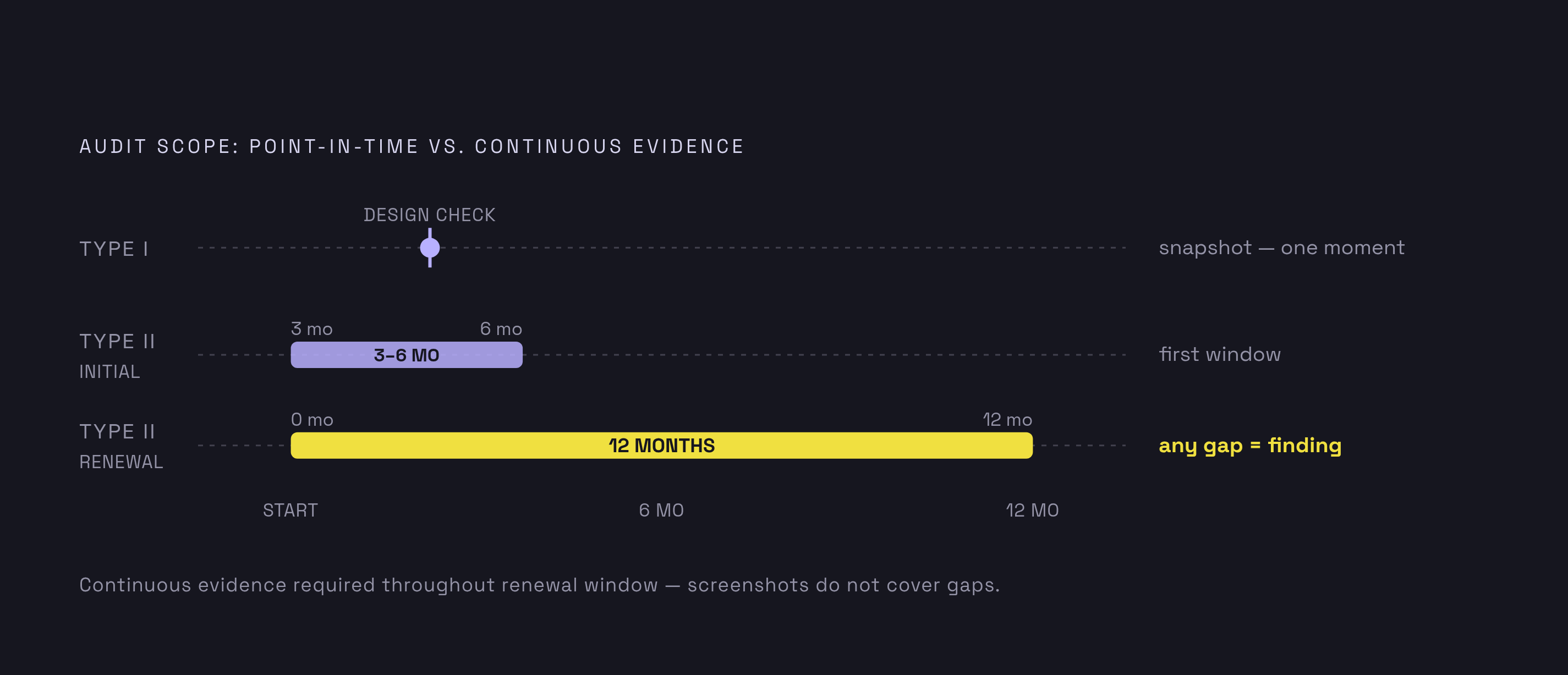
Type I evaluates control design and implementation at a specific point in time, whereas Type II assesses their effectiveness over time. The observation window is generally 3–12 months: a first audit covers 3–6 months, and renewals cover 12 months. To test this, auditors select a sample of merged pull requests and verify that each change received the necessary review and remained on protected branches. Merging a change without branch protection during that period constitutes a finding.
Default GitHub settings don’t build that record. The organization lacks enforced MFA, active branch protection, enabled secret scanning, and any CODEOWNERS documentation. Without external streaming or storage of audit logs, GitHub-side records can vanish before the observation window closes, leaving a gap. Pre-fieldwork screenshots merely confirm how things were set up when the image was taken. As a result, timing begins only once safeguards are proven operational, and any setup error may force a reset.
The six GitHub configurations that constitute the core CC6, CC7, and CC8.1 technical controls
Protected branches are the primary tool for enforcing CC8.1. Teams ought to demand approval from at least one reviewer plus green status checks before any merge, void earlier approvals once fresh commits land, and bar pushes straight onto branches that are protected. Where it fits the team's workflow, linear history can keep a readable merge record.
Requiring MFA across the organization satisfies CC6.1, since merely suggesting it falls short of enforcement. Leveraging GitHub teams to restrict repository permissions, keeping owner and admin counts low, and tying collaborator revocation to offboarding are essential practices. Scheduled, documented access reviews must encompass both internal collaborators and outside contributors. Within the overall CC6 framework, CC6.3 is where role separation and least privilege mainly apply.
CODEOWNERS maps high-risk areas to their responsible reviewers. Rules for infrastructure-as-code, secrets setup, and authentication code should require owner approval before changes are merged. The file has value only when its required reviews are enforced. Separating who builds, checks, and releases ensures one developer cannot solely sign off on sensitive changes they made, while tying permissions oversight to the authorization expectations in CC8.1.
Under CC7.1, Dependabot automatically identifies known vulnerabilities in dependencies. At the deployment stage, ECR scanning on push adds to that coverage by checking every container image as it is added to the registry. These records together link source dependency checks with the image the pipeline introduces.
CC6.8 exposure concerns are addressed through secret scanning paired with push protection. Before commits carrying detected secrets can land in the repository, push protection stops them, and that block event shows the control ran. Here, prevention itself is what produces evidence. Where CodeQL or a comparable SAST tool runs, it examines more than secrets hardcoded into source, extending CC6.6 reach.
Streaming audit logs gives teams tenantwide evidence to support CC7.2 oversight. Teams should send logs into an immutable outside store, for example AWS S3 using object lock, so evidence for the observation period is not erased by GitHub-side expiry. Keep retention periods longer than GitHub’s built-in expiry. Protected change records show code edits, while outside audit events supply the access and configuration context for reading them.
How to build the deployment layer so the same image travels through every environment with its evidence intact
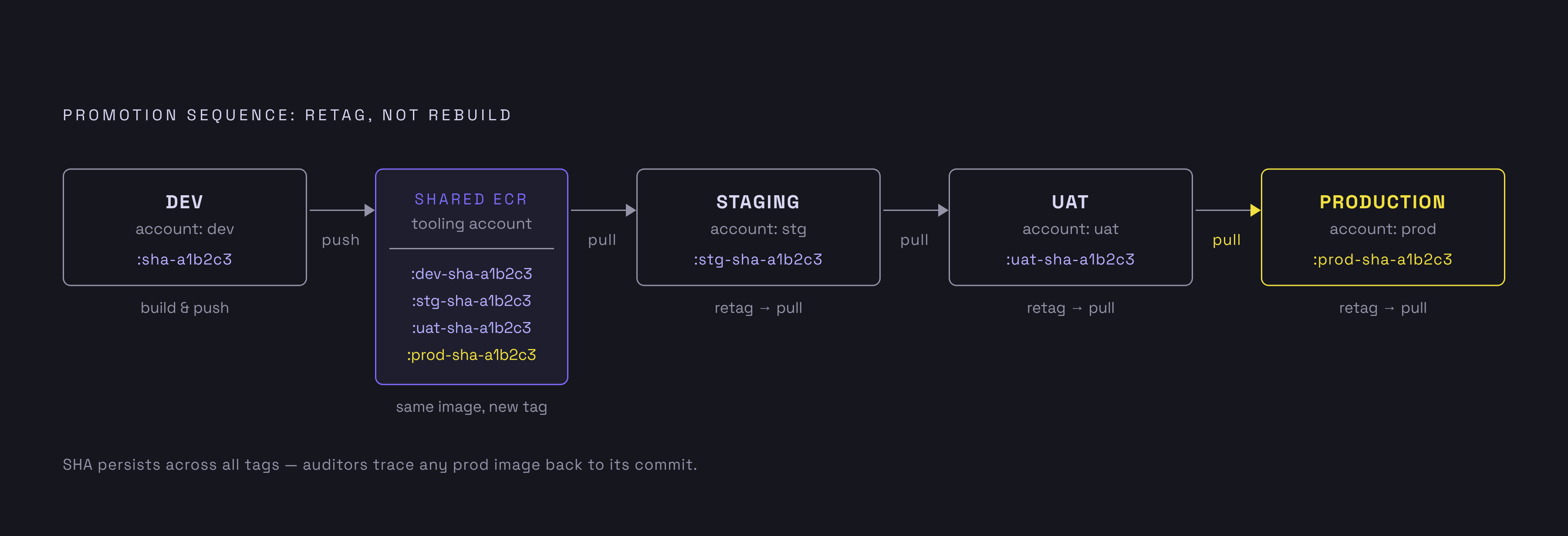
Repository evidence falls short when production deploys an artifact that differs from what was tested. Promotion must preserve artifact identity. Under CC6.1, this AWS design places dev, staging, UAT, and production in separate accounts, creating trackable logical access boundaries. ECR lives in a shared-tooling account, environment accounts can only pull images across accounts, and the pipeline can push solely to that central registry. The pipeline therefore governs and records each image's arrival.
Teams should move the same container image forward through retagging, since rebuilding breaks the connection to earlier tests and scans. Embedding the commit SHA within the image tag links the production image to the code modification and its merge history. ECR lifecycle rules ought to retain staging plus production-tagged images across the most recent several hundred releases regardless of age, whereas untagged or dev-tagged ones may expire sooner.
OIDC hands out deployment credentials without keeping static AWS keys inside GitHub secrets. During execution, the pipeline trades a temporary identity token for cloud access. The trust policy makes the scope explicit. By checking the sub claim, the policy limits who may assume the role to a single repository and job context like a tag, pull request, environment, or branch. The IAM layer blocks other callers, so the access boundary is structural.
Why the pipeline itself became an attack surface, and what the tj-actions supply chain attack means for CC6 controls
When a pipeline is breached, the evidence it produces can no longer be trusted. StepSecurity's probe into that incident revealed a hijacked PAT bound to @tj-actions-bot alongside hostile scripts that harvested runner memory contents and dumped obfuscated credentials to workflow logs. Because tags pointing to Actions may shift at the source, teams can execute rogue code through configurations that appear untouched.
To counter this, teams SHA-pin external Actions, vet them like any supply-chain dependency, and limit which Actions organization policies permit. By limiting which code can reach pipeline resources, these measures reinforce CC6.1 as well as CC6.6. OIDC reduces exposure further by substituting temporary, job-specific credentials for long-lived cloud keys. This eliminates the persistent credential category that attackers target.
On April 2, 2026, GitHub opened up repository custom property claims within Actions OIDC tokens to all users. Those properties now determine which roles get assumed. This introduces finer-grained boundaries than the job and repository details previously embedded in the token, offering teams a tighter way to set cloud access restrictions.
The coming GitHub Actions scoped-secrets model and what it changes for least-privilege evidence
Teams should also review the least-privilege line around reusable workflows before scoped Secrets are introduced. By default, Secrets are not forwarded on their own. Callers must choose what to share, yet broad inheritance can still carry credentials across reusable workflows without recipient-level binding detail. Under the new approach, jobs relying on broad inheritance may fail as that trust line shifts.
Teams need to verify the exact secrets every reusable workflow demands and declare those bindings clearly before an observation window gets disrupted by the change. Defining permissions this precisely bolsters the evidence trail. When evaluating CC6.1 controls over access, reviewers can examine the binding directly rather than relying on written rules that claim permissions are limited. Similarly, GitHub enforces technical controls over cloud credentials through repository-property claims that dictate which recipients are authorized.
Two evidence gaps auditors are starting to flag: feature flags and AI-generated code
Feature flags can shift production behavior outside the pull request and CI pipeline, leaving the deployment record missing the change. If a toggle affects permissions, application decisions, or access to information, it belongs in production change management, even if no new code is released. For security-sensitive flag updates, teams should use documented sign-off that records evidence inside the flag platform, or route the work through the code pull request workflow. GitHub branch protection, on its own, has no control over an independent flag tool.
AI-generated code opens a separate hole in how review is evidenced. Under CC8.1, the author's identity makes no difference to how code is treated. Every modification requires documented approval, testing, and authorization, along with proof that a person looked at it before merge. Auditors flag issues when teams cannot produce that review or define the criteria for evaluating machine-written updates. Teams should enforce identical scrutiny for machine output via branch protection, CODEOWNERS, and a written policy spelling out exactly what reviewers must confirm.
The linkage problem: why evidence scattered across tools fails even when every individual control passes
What is often missing is the connection. The ticket, the approval on a pull request, CI output, a deployment event, and the live production version can each reside in separate systems with no formal linkage. Auditors need a path from the request to production that brings the evidence together without hand-built reconstruction. Tagging images by commit is useful, but the audit trail must include approvals and run results in between.
Configuration drift disrupts that chain while the system is running. A commit record captures the intended infrastructure configuration, potentially diverging from the live state. Auditors rely on automated scanners that check live systems against infrastructure-as-code definitions, revealing modifications the repository history cannot account for. Consequently, undetected configuration drift undermines confidence that approved source changes accurately represent production.
Drafted conclusions, templated board minutes, and baseline risk evaluations assert results while remaining disconnected from active controls. Genuine records derive their proof from verifiable sources. Records of pull requests, Actions logs, and API responses for branch protection reveal what was truly configured and what occurred. Continuous automated compliance testing handles this gap by checking the active environment and keeping every success or failure as proof.
Turning the configured pipeline into a continuous evidence machine: what automation handles and what engineers still own
Continuous compliance automation verifies GitHub’s current organization settings directly, rather than depending on a person’s confirmation that they exist. Routine scans can use the API to verify review rules and protected branches, MFA, collaborator access, CODEOWNERS coverage, secret detection, push safeguards, plus audit log delivery and storage. A single automated check both flags drift and captures control status, so teams need fewer isolated exports or rushed screenshots.
One option here is Strac Comply. It runs ongoing checks on GitHub organizations for CIS GitHub Foundations Benchmark compliance and for the SOC 2 rules covering how changes are managed and how code is kept secure. Each check lines up with one Trust Services Criterion, with daily results forming the evidence record. That job is different from what a checklist tool does with attestations, yet engineers still keep control design on their own shoulders.
Pipeline integrity, scope, and policy remain the responsibility of engineers. Any platform handling buyer information, impacting public uptime, retaining live secrets, or posing a breach risk upon compromise belongs inside this perimeter. Drawing the perimeter too wide creates needless proof obligations. The perimeter needs network segmentation as proof, and written rules must govern AI-code assessments plus feature-flag sign-offs. Engineers also keep SHA-pinning Actions and maintain the approved-Actions policy.
Under the AICPA proposal, the 2026 attestation-standards project would tighten proof-gathering and risk-review duties across AT-C 105, 205, plus 210. June 15, 2029 is the proposed start date, but no final standard existed by August 22, 2026. For engineers, the immediate obligation stands regardless of the proposal. From the observation period’s first day, controls have to produce evidence, because a missing trail cannot be recreated by adding automation later. Once the pipeline produces that record by design, engineering owns SOC 2 readiness.