Control Drift Detection in Cloud-Native Environments
How security controls drift silently in production until an audit or breach exposes it.
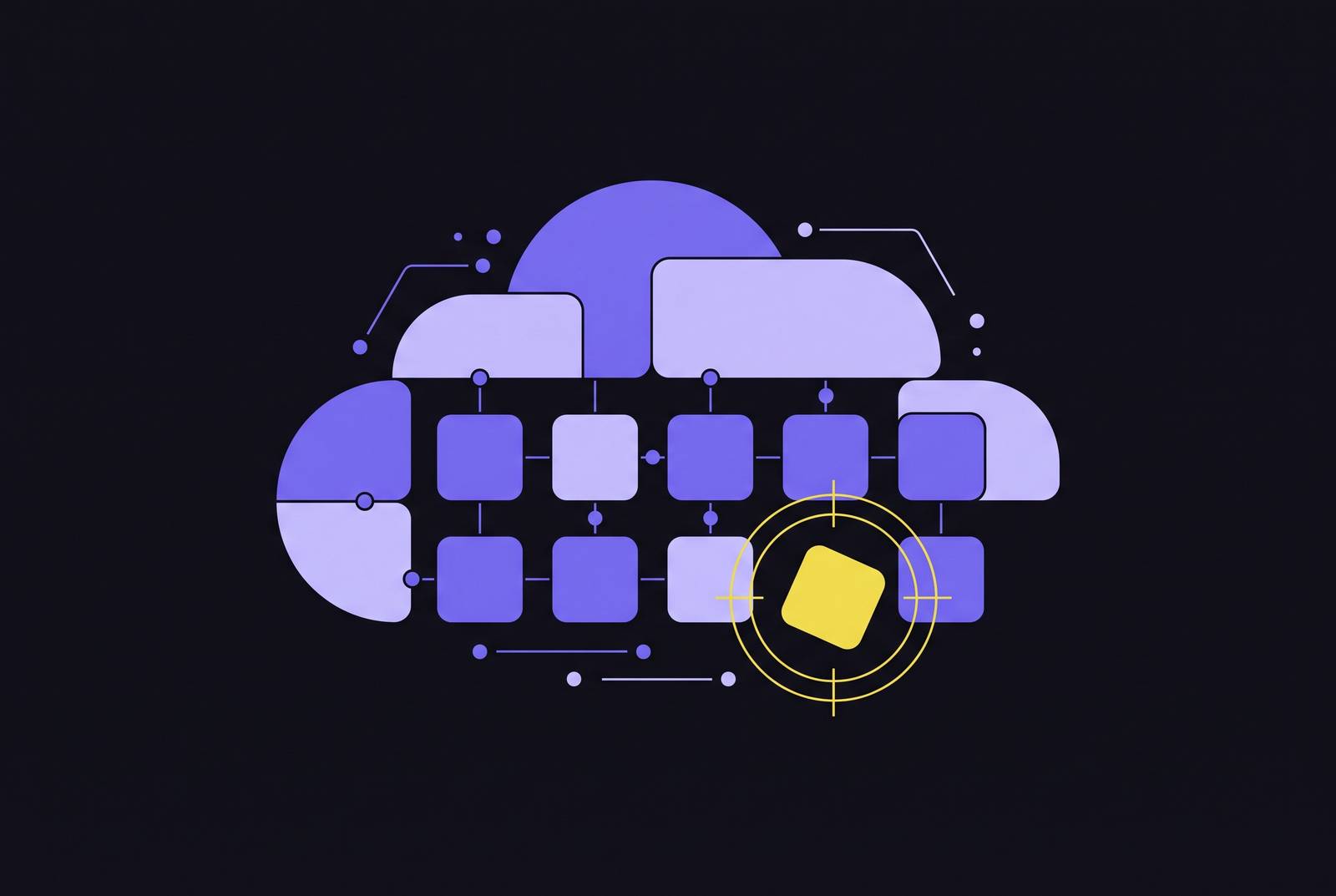
Control drift is what happens when the security and compliance settings running in production quietly stop matching what your code says they should be. Not the CPU allocation, not the load balancer timeout — the specific controls: RBAC roles, IAM policies, firewall rules, encryption flags. This piece is about how that gap opens, why cloud-native environments make it worse, and what actually closes it before an auditor or an attacker finds it first.
Start with the vocabulary, because it matters here more than usual. Infrastructure drift, broadly, is any mismatch between declared state and running state, and most of it is boring. A forgotten instance size change, a manually bumped memory limit, a load balancer someone tuned by hand during a traffic spike. That kind of drift costs money and occasionally costs uptime. Control drift is a subset, and it's the dangerous one: it's specifically the erosion of the settings that security frameworks and compliance audits are built around. An IAM policy in Terraform gets a wildcard added, and read-only turns into full access. A Kubernetes role defined as read-only in code gets edited live to allow write and delete. An S3 bucket goes public for ten minutes to share one file with a contractor, and nobody flips it back. None of these show up as an outage. All of them show up, eventually, as an incident report.
How individually reasonable changes accumulate into systemic exposure
Here's the uncomfortable part: almost none of this drift starts as negligence. Each change, taken on its own, made sense to the person who made it.
A security engineer opens a debug port at 2am during an incident, gets the fire out, and moves on to the postmortem without closing the port. A developer widens an IAM policy because production is down and the narrower policy is blocking the fix, and scoping it back becomes a task that never makes it off the backlog. A company acquires another business unit, inherits its infrastructure, and that infrastructure was never written in Terraform or CloudFormation to begin with; it just runs, off to the side, outside whatever governance the rest of the estate has. Each of these is a locally rational decision made under real constraints. Stacked together, across a few hundred engineers and a few years, they add up to an environment that passed its last compliance assessment on paper while sitting on live, exploitable exposure in practice.
Part of the reason this compounds so easily is structural. In most enterprises, only 60 to 80% of cloud resources are actually defined in infrastructure-as-code; the rest exist because of inherited workloads, acquisitions, or teams that shipped features first and never went back to backfill the IaC. That remaining 20 to 40% is where drift hides best, because there's no code to compare it against in the first place. There's no baseline to drift from. It's simply unaccounted for.
Multi-cloud makes the math worse. Roughly 88% of organizations now run hybrid or multi-cloud setups, and multi-cloud configurations increase security misalignment risk by an estimated 31% compared to a single-cloud deployment. More providers means more consoles, more APIs, more places a permission can quietly widen without a shared control plane to notice. Drift doesn't send a memo when it happens. It just sits in the space between the last known-good state and whatever is currently running, and that space gets wider every time you add another account, cluster, or cloud.
The real scope of damage drift is causing in 2024–2025
The headline number: 55% of cloud breaches in 2025 trace back to configuration drift or oversight. That's not a niche failure mode. That's the majority.
Pull that thread and the picture gets more specific, not less. About 80% of cloud security incidents stem from human error, inconsistent policy enforcement, or weak change control, which tells you this is mostly a process failure wearing a technical costume. Around 70% of cloud environments contain at least one publicly exposed resource right now. Roughly 54% have credentials hard-coded somewhere in a config file or a container image. And AWS S3 misconfigurations alone account for 16% of cloud security breaches, which means one storage service, mishandled in one specific way, explains a meaningful chunk of everything.
Visibility is the other half of the problem. About 40% of enterprises admit they have poor visibility into their own cloud configurations, and 66% of security leaders say they lack confidence in their ability to detect and respond to cloud threats in real time. Put those two together and you get organizations that are, functionally, driving with a cracked windshield: they can see enough to keep moving, not enough to see what's about to hit them.
The financial argument for catching this early is not abstract. IBM's 2024 Cost of a Data Breach Report puts the average global breach at $4.88 million, and organizations that contained a breach within 30 days saved an average of $1.12 million compared to those that took longer. Detection speed is where that $1.12 million is won or lost. And here's the twist that should bother anyone who thinks buying a scanner solves this: per Firefly's 2024 State of Infrastructure as Code Report, 13% of detected drift is never remediated at all. Detected, logged, and then left alone. A smoke alarm that everyone hears and nobody responds to isn't really a safety system anymore; it's ambient noise.
Why Kubernetes and containerized workloads create their own drift surface
Kubernetes deserves its own section here because misconfiguration is a persistent and well-documented source of Kubernetes vulnerabilities: RBAC roles with more permission than the workload needs, services exposed with no authentication in front of them, network policies loose enough to let traffic wander where it shouldn't.
But what makes Kubernetes structurally different from a plain cloud VM setup? Self-healing and autoscaling, for one. A cluster that resurrects a pod or reschedules a workload can silently alter running state in ways no human signed off on in the moment. Layer on top of that the sheer number of places a declarative config lives: kube-proxy settings, deployment YAML, the CNI plugin's own YAML, and the Terraform HCL that provisioned the cluster underneath all of it. That's four separate surfaces where the same underlying intent gets expressed, and four separate places drift can sneak in without the others noticing.
The sharpest example is the direct kubectl edit. Someone patches a live resource straight in the cluster to fix something urgent, and that change is invisible to Terraform's state file until somebody runs a plan and Terraform notices the world moved without asking permission. This is the layering problem in miniature: if Terraform provisioned the cluster and separate manifests define what runs inside it, drift can live at either layer, or both simultaneously, and they don't report to the same dashboard. A detection setup that only watches Terraform state misses the kubectl edit entirely. One that only watches the cluster runtime misses drift in how the cluster itself was provisioned. You need both, watched separately, reconciled together.
The detection toolkit, from native IaC commands to purpose-built platforms
Start with what's already sitting in most toolchains, because the baseline is more capable than people give it credit for, and also more limited than people assume.
terraform plan compares the state described in your configuration files against the actual state of provisioned resources, and terraform apply reconciles the difference back to what code says it should be. AWS CloudFormation ships its own built-in drift detection for stacks. The catch with both: they're point-in-time and manual. They catch drift the moment someone runs the command, not the moment drift actually happens. A misconfigured IAM policy sitting for six hours before the next scheduled plan is still six hours of live exposure.
Open-source tools fill in some of the gaps. Driftctl integrates with Terraform, maps live cloud resources back to state, and specifically flags resources that exist but were never brought under IaC management, which, given that most enterprises define only 60 to 80% of resources in IaC, is exactly the blind spot that matters most. KubeDiff is built for comparing Kubernetes configs specifically. Kyverno blocks non-compliant configurations at admission time, before they're allowed into the cluster, but it has no power to revert something already running and already drifted. Open Policy Agent, OPA, handles policy-as-code enforcement and slots into CI pipelines and GitOps flows so that policy checks happen before merge, not after.
GitOps tools like ArgoCD and FluxCD take a different approach: Git is the single source of truth, and any divergence between what's declared in the repo and what's actually running triggers automatic reconciliation. This is powerful, but it has a specific blind spot worth naming directly. ArgoCD reverts drift once it's already live in the cluster; it cannot stop a bad pull request from merging in the first place. CI catches problems at PR time, before merge, but it has nothing to say about a kubectl edit applied straight to the cluster after the fact. GitHub Actions can automate the deployment pipeline itself, but it doesn't have ArgoCD's continuous reconciliation loop watching the cluster afterward. Each tool is built to watch a different layer, and no single one closes the whole loop.
Commercial platforms try to stitch the layers together. Spacelift layers drift detection across Terraform, Pulumi, CloudFormation, and Kubernetes from one control plane, with an OPA-based policy engine that defines what drift is tolerable and what should trigger automatic remediation. env0 runs continuous drift scanning across Terraform and OpenTofu environments and auto-reconciles by opening pull requests, pairing that with cost visibility and developer self-service. SIEM platforms, Splunk, Microsoft Sentinel, Sumo Logic among them, ingest configuration logs to flag anomalies and unauthorized changes; they're strong for audit trails and correlating activity across environments, weaker as a real-time remediation mechanism.
Here's what all of these share, commercial or open-source, native or purpose-built: they're mostly polling-based. And polling has a window built into it.
Event-driven detection and why polling-based approaches leave a window open
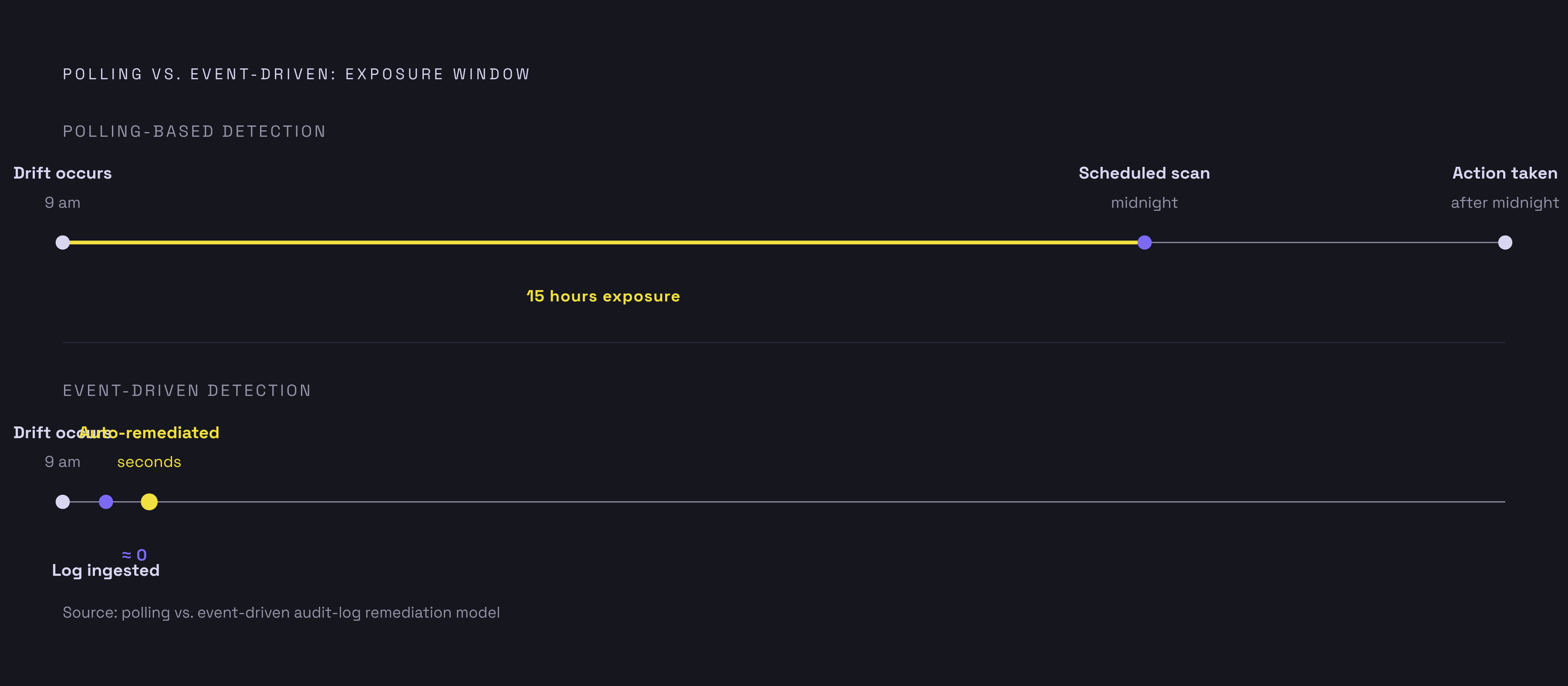
Picture the timeline concretely. Drift detection typically runs on a schedule: hourly, daily, sometimes only when someone remembers to trigger it manually. A firewall rule gets opened at 9am. The scheduled scan doesn't run again until midnight. That's fifteen hours where a change nobody approved sits there, live, doing whatever it's going to do, before any detection system even looks at it.
Detection by itself doesn't close that window; only action does. The real exposure lives in the gap between when drift occurs and when someone, or something, acts on it. Auto-remediation, meaning a system that triggers a fix the instant a resource crosses into a non-compliant state, is what actually shrinks that window down to something closer to zero.
The architecture that gets closest to closing it combines two things: continuous analysis of cloud audit logs, which catch control-plane changes like API calls and policy edits, and eBPF-based monitoring at the system level, which watches data-plane activity as it happens. Together they treat every configuration event as its own trigger rather than waiting for the next scheduled check-in. That requires real-time ingestion of something like CloudTrail or Kubernetes audit logs, plus a remediation workflow willing to act without waiting for a human to click approve, at least for the well-understood, low-ambiguity cases, while still escalating anything genuinely unclear to a person. The financial case for building this is not subtle: per IBM's 2024 data, organizations that applied AI and automation to security prevention saved an average of $2.22 million compared to those that didn't. That's the kind of number that gets a CISO a seat at the next planning meeting.
Where AI and ML are changing what drift detection can surface
Static rule sets have a ceiling, and it's worth being precise about why. Cloud workload behavior isn't one pattern; it's a mix of static, periodic, sudden, unpredictable, and continuously shifting activity happening at the same time across the same environment. A fixed rule, written once, can't tell the difference between a legitimate architectural change and a security-relevant one when the underlying behavior keeps moving.
Recent research tackles this with an AI-driven approach that trains models on infrastructure-as-code and cloud configuration logs. As new configuration data comes in, such approaches flag anomalies, raise alerts, and can optionally trigger auto-remediation, updating on new patterns instead of freezing around one static baseline. That last part matters more than it sounds: an environment that changes shape every quarter needs a detection model willing to change shape with it.
Separate research takes on a subtler problem. Most agentic detection systems assume the tools feeding them information are trustworthy; RIVA is built for the case where a tool itself returns an incorrect or misleading result, and the system needs to figure out whether the anomaly is a real infrastructure problem or a broken tool lying to it. Such systems use specialized agents that cross-check each other through iterative back-and-forth and by tracking the history of tool calls over time, improving accuracy over approaches that trust tool outputs uncritically. Worth sitting with the baseline for a second: that's roughly how well a detection agent performs when it simply trusts whatever a broken tool tells it. Not great odds for anyone relying on it.
None of this touches governance, though, and it's worth being blunt about that gap rather than glossing over it. Who owns the decision to auto-remediate a finding? How does a drift alert map onto a specific compliance framework's control number? Does an automated fix in a regulated environment create its own audit trail requirement that the fix itself doesn't satisfy? Governance-as-code adoption rose 45% in 2025, largely because organizations ran into exactly this wall: AI can surface drift faster than any human team could manually, but detection without policy ownership attached produces a pile of alerts, not an accountable process.
Building a detection workflow that actually prevents compounding
So what does a workflow look like that actually holds up, instead of just producing another dashboard nobody checks? Layered, mostly, because no single tool covers every stage where drift can enter.
CI pipelines catch bad configuration before it ever merges, using OPA policy checks or Kyverno admission review as the gate. GitOps reconciliation, through ArgoCD or FluxCD, continuously compares what's declared against what's live and reverts unauthorized changes automatically. IaC state comparison, scheduled Terraform plans, Driftctl scans for unmanaged resources, surfaces drift in the infrastructure layer itself. Audit log analysis through CloudTrail, Kubernetes audit logs, or SIEM ingestion catches the changes that slip past every IaC layer entirely, the kubectl edits and console clicks that never touch a pull request. And ML-based anomaly detection picks up the patterns that a fixed rule set is structurally unable to catch at scale.
Remediation needs to sit inside that detection layer, not bolted on afterward as a separate ticket queue. Well-understood, low-ambiguity drift, a known-bad wildcard added to an IAM policy, is a fine candidate for automatic remediation with full logging attached. Genuinely ambiguous drift, a network policy change that might reflect a real architectural decision someone made on purpose, deserves an alert with context and a human in the loop, not an automatic revert that undoes legitimate work.
That 13% of detected drift that never gets remediated, from Firefly's 2024 report, is really the whole ballgame. This is a routing failure more than a tooling one. Detection that doesn't land on a specific owner with a specific next action accomplishes very little. Organizations built around centralized governance frameworks see roughly 40% fewer high-severity vulnerabilities, which is a fairly direct way of saying: the tooling is necessary, but it's not sufficient without someone whose job it is to own what the tooling finds.
The teams that get this right tend to work backward from where most start. They define what "compliant state" actually means, control by control, before they go shopping for a detection platform, so the tooling has something real to measure against instead of measuring against whatever the last engineer happened to configure. Start with the baseline. Let the tooling follow it.