Audit Automation Platforms for SOC 2 Compared
Five variables reveal which platform actually runs your Type II audit window without breaking.
Every SOC 2 audit automation platform offers an identical result: a report free of exceptions. That guarantee hinges on tools that fall into two distinct buckets, and choosing poorly burns through quarters of cleanup, not just a handful of tossed-out fees. This guide compares those platforms likely to dominate in the 2026 market by checking five variables that actually show if each Type II observation window runs smoothly or breaks during month seven.
How five variables tell platforms apart
Every vendor pitch mentions "automation," but the word covers wildly different amounts of actual work. Five variables are what actually set vendors apart.
Since any platform watches only what it touches, Integration depth plus breadth count first. What matters isn't only the number of integrations, but if each one pulls information in batches or continuously, plus if cloud infrastructure, HR, identity, and code repositories each get included. Any gap in the listed categories becomes manual evidence work down the line, and audit risk concentrates around manual evidence.
Evidence collection depth comes next, breaking into tiers: automated (the platform pulls it), partially automated (the platform collects most while a person confirms it), and manual (a person drops in a screenshot). Stronger platforms surface stale evidence or gaps ahead of the auditor's first request. The weaker ones leave a gap hidden until sampling hits the worst time.
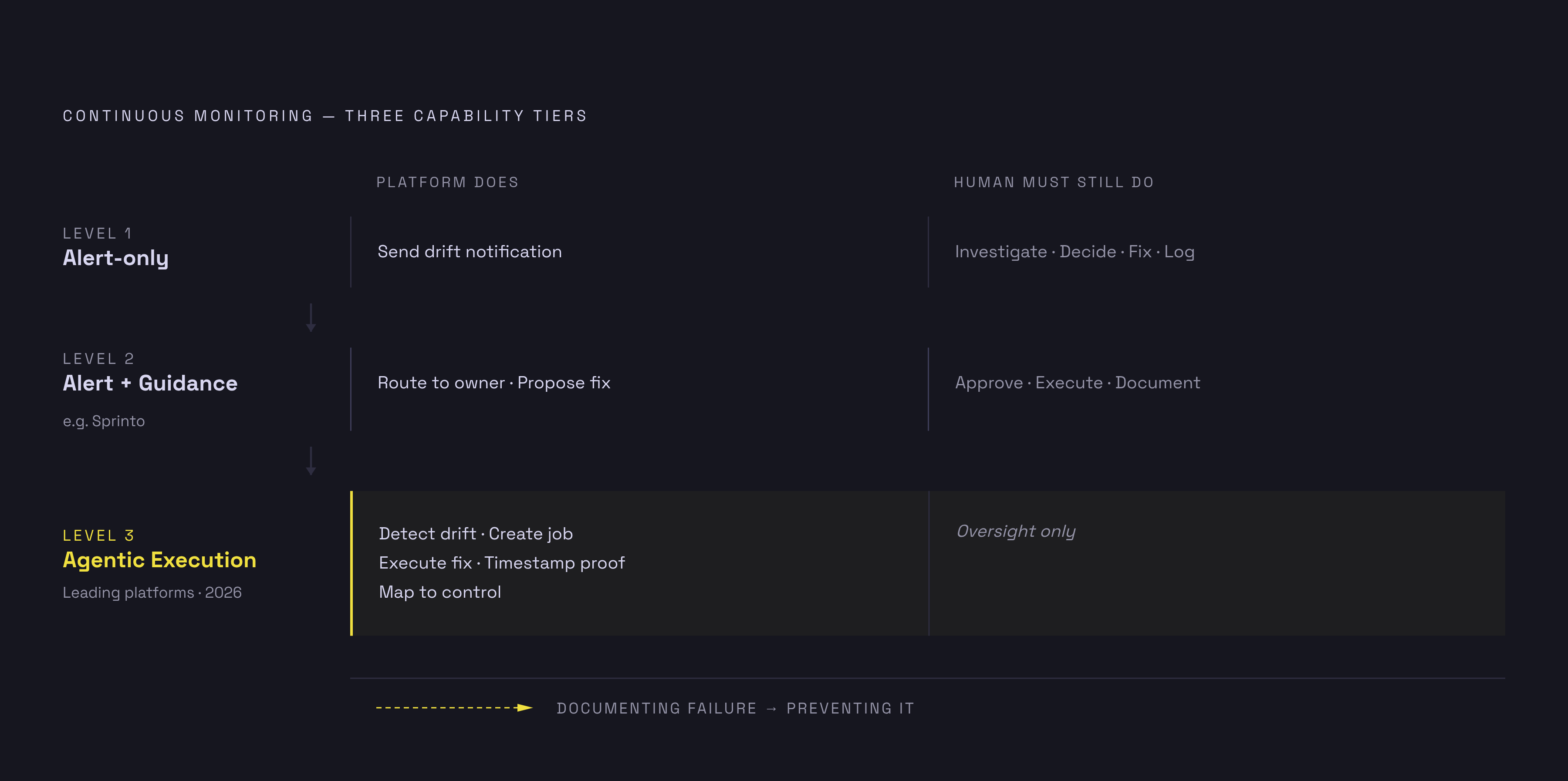
Ongoing monitoring comes next, and that's where things are actually headed during 2026. Alert-only checks that just ping a chat when something drifts are the bare minimum today. That no longer sets a platform apart. What actually separates platforms is whether they just send a warning or handle everything: spot drift, create a job, then propose to fix it or execute the change while saving audit-ready proof alongside one timestamp plus mapping attached.
Pricing model and total cost is the fourth variable, and it's messier than any vendor's pricing page suggests. Software prices differ a lot for these companies, and the key figure is the total year-one spend after review bills are included. Some programs can run well beyond typical totals. Per-seat, fixed, and tiered-by-framework models each shift the total in their own way based on if a business wants a single standard or several.
People tend to miss this point until they're stuck: choosing Type I or Type II. Some tools help a business reach its first attestation quickly. Some handle the long audit period without missing a thing. They’re different products solving different needs, and choosing the poor fit for a company’s schedule wastes cash plus runway.
A fifth divide grows from one extra split, setting apart tools that show controls are there from those that run them. Under the 2017 Trust Services Criteria with 2022's refreshed guidance, auditors must do more than see that the policy document exists; they have to test operating effectiveness during a Type II engagement. Everything else here keeps circling to that one dividing rule.
Vanta: broadest integration catalog and the fastest route to a first audit
Vanta ranks first for G2's Best Governance, Risk & Compliance Products in 2026, with Leader status from Forrester Wave covering GRC Platforms Q2 2026, plus IDC MarketScape's Worldwide GRC Software 2025 report. It hit 63 in that year's 2025 Forbes Cloud 100 ranking, three years running on the list, plus it joined the 2025-2026 edition of Fortune Cyber 60. It's strong validation of a compliance tool, yet its scale numbers prove it: with 400 integrations spanning identity, cloud, HR, code, and security, plus 1,400 automated hourly tests over 35-plus frameworks, including customers like GitHub, Duolingo, and Atlassian.
Vanta AI Agent 2.0 gave the AI layer a big lift in January 2026: this context-aware agent spots gaps, drafts policy text, gives security questionnaires a first try, and checks evidence ahead of any person. Vanta also has extra tools for handling third-party risk plus buyer trust.
Pricing runs quote-based with Vanta offering no rate card, though third-party directory sources put single-framework pricing at about $10,000 annually for businesses with fewer than 50 employees. A common complaint is that AI-generated SOC 2 control text feels basic, so a person still has to fix it before any review happens.
For a compliance owner who isn’t technical, Vanta fits best. A polished, guided setup helps Founders and legal counsel or ops staff working alone, since it lowers chances of any accidental gap mid-window. It may not suit teams managing multi-framework programs, as its guided workflow can limit flexibility.
Drata: the engineering-team choice for multi-framework programs
Among leading evidence-only platforms, Drata's risk program runs deepest. It includes a library of 200 prebuilt risk scenarios based on NIST 800-30, ISO 27005, plus the OCR SRA tool supporting HIPAA risk assessments. The monitoring model works continuously, with read-only cloud reviews repeating about once daily. In 2026, the company combined over 1,000 system checks into one Test Library, reducing the mess of handling them standard by standard.
It earns a 4.7/5 score from 1,331 G2 reviewers. Pricing stays private, though One third-party observation puts single-framework fees near $9,000 for companies with 10 to 50 employees, plus extra frameworks.
An engineering-heavy group that needs the API to work with, avoids a point-and-click wizard, and likes minimal guardrails plus hand-holding will do best with Drata. SecureLeap's buyer guide calls it the most cost-effective pick for any organization handling two or more compliance frameworks, such as SOC 2 and ISO 27001 alongside HIPAA, within an 18-month stretch, and the bundled multi-framework tiers usually come in cheaper than buying each one on its own. For groups running their infrastructure mostly on AWS, Drata's AWS Security Competency designation matters. Where it trails Vanta is guided help, a real issue for organizations without a dedicated owner in charge.
Secureframe: the managed-support option for teams without an internal compliance owner
Secureframe's positioning starts with another different idea: many businesses pursuing SOC 2 lack someone internally to run it full-time. The compliance manager model assigns one point person, someone who will actually run things, making it unique among the main platforms in that it reduces internal work, not merely organizing tasks in one dashboard.
Its AI is task-focused, less conversational. When cloud tests don't pass, Comply AI's Remediation generates infrastructure-as-code fixes through Terraform, AWS CLI, AWS CloudFormation, AWS CDK, Azure Resource Manager, and GCP Deployment Manager. AI Evidence Validation spots evidence that is stale or not there before an audit finds it. Of all the options covered here, it's the most hands-on AI tool aimed at infrastructure staff in this group; it generates output an engineer can really execute, not just a hint.
Secureframe takes No. 4 in G2's Best Governance, Risk & Compliance Products rankings for 2026. No other vendor in this group offers purpose-built CMMC plans, or lists TX-RAMP certifications. For customers in sectors facing heavy oversight and government work, timing counts: TX-RAMP and CMMC Level 2 carry approval to 2028, while FedRAMP 20x Class C (Moderate) starts June 23, 2026, with a prior 20x Low approval that had lasted until August 20, 2026.
Some buyer guides flag it as one of the more expensive options when compliance support is included, even though soc2certification.com lists pricing beginning near $7,500. That fits teams lacking an internal compliance owner, firms pursuing CMMC, plus SMBs who prefer guidance bundled with software over running a tool themselves. A few tiers bundle vulnerability assessments plus penetration checks, so early-stage groups coordinate fewer vendors.
Sprinto: lowest friction for early-stage teams with straightforward cloud setups
Sprinto's stands out by warning in stages as checks get close to breaking, sending the right person remediation guidance to handle. Among platforms that are evidence-only, this one comes nearest to actual remediation without using agentic AI for completion.
For a tool this narrow, the numbers are sizable: 3,000+ customers, more than 300 integrations, coverage of over 200 frameworks, and 4,500+ audits passed. On G2, 1,400 reviewers give it 4.8 stars out of 5. The pricing approach breaks from the norm: nothing per seat, no extras, one price covers everything. Outside figures suggest pricing may vary by company size.
Sprinto's best buyer: any early-stage startup on one cloud, preparing for its first SOC 2 Type II and a small tech staff that wants a quick setup. Distributed groups benefit most from this hands-off, work-when-you-want approach.
Even so, these gaps knock Sprinto out of the running for some buyers outright. Its compliance coverage and GRC capabilities are more limited compared to some enterprise-focused platforms. No pricing level lists automated provisioning or SCIM. DSPM and in-house data-loss prevention tools aren't included. Some third-party comparisons suggest it may not suit large companies managing multiple frameworks at scale.
Thoropass, Scrut Automation, and Scytale: where bundled audit delivery and GRC depth matter
Thoropass works differently: it connects its compliance automation software with one affiliated CPA firm, one that stays distinct on paper, putting audit and platform under one deal. In April 2026, the company served over 1,200 customers, had a team of more than 200 workers in 12 countries or beyond, and handled 30 compliance frameworks. Pricing begins at roughly $8,700 for the platform, according to third-party sources, while combined platform-and-audit bundles may range from $14,500 to over $30,000 annually. It suits a company trying to skip managing two vendor accounts and accept higher costs for ease, but an affiliated-entity setup brings real auditor-independence concerns for legal counsel to check before buying.
G2's Winter 2025 Report confirms what Scrut Automation claims: it works as one unified GRC platform, not just a SOC 2 tool, earning 11 Momentum Leader badges and 257 more badges in other categories. It comes bundled with over 100 pre-built, customizable templates, handles more than 80% of evidence gathering tied to pre-mapped SOC 2 controls, links through over 75 integrations, plus it puts customers in touch with in-house compliance pros counting 50-plus years among them. One single-window model handles SOC 2, ISO 27001, CCPA, GDPR, and HIPAA, plus extra frameworks. Scrut's platform comparison highlights this tradeoff: a challenging setup that fits mid-market plus enterprise organizations ready to invest upfront for sustained visibility over the long-term, yet frustrates those seeking rapid deployment.
Auditors created Scytale instead of software teams, which comes through in how the workflow moves: a straight sequence from readiness toward the audit itself, where AI-powered automation covers evidence collection alongside ongoing monitoring while running a Trust Center and assigning one compliance specialist at every point. HackerNoon's assessment highlights its AI-powered automation and expert consulting as key differentiators. Pricing stays quote-only, with no rate card on hand. Like Secureframe's buyer, Scytale's workflow keeps an auditor's view baked through each phase instead of any software approach, aimed at people who want guided help from real experts.
Strac Comply: what changes when the platform runs the controls, not just proves them
Being ready for an audit isn't the same as being safe, and that's the whole reason Strac Comply exists. Even a platform might show an auditor all required evidence, yet that company remains open to the same breach which triggers the report a year out. With its 2022 update, Trust Services Criteria made audit teams test control performance itself, not just check a rule file was sitting in cloud storage, and that is exactly the hole proof-only platforms create.
Strac Comply's platform-level approach bundles evidence collection with built-in DLP, security posture (DSPM) plus OAuth governance tooling. Instead of gathering evidence showing CC6.x rules are set up, the tool does them directly, so its records reflect what it does and not another team's work.
Pricing starts from $9,500 annually, according to the guide from Strac, landing it mid-range among evidence-only tools while including a full active-security layer. It works best when compliance and real security have to stay together, something more AI/ML makers face as CC6 scrutiny hits them under 2024-2025 AICPA rules (which aren't binding yet; nothing officially puts AI/ML tools in CC6 scope, but the people checking are getting harder anyway). One fair warning: a firm already using top-tier DSPM and DLP products on their own might not gain much added benefit here. Companies starting their data-protection layer at zero benefit most.
How Type I vs. Type II timelines should drive the platform decision
Type I or Type II isn't a case of two flavors in one report; each is its own engagement with its own failure mode, and the platform each company actually wants to get should match that goal. The Type I review examines how safeguards get set up at one moment, and it wraps within 30 to 60 days. Type II examines control setup and operating effectiveness over a 3-to-12 observation window; until the vendor agreement is in place, most enterprise buyers demand a Type II report.
That distinction redefines the role "automation" has to play. With Type I engagement, reaching first attestation quickly matters most, while any platform like Vanta made around guided setup with a large integration catalog helps the company get there quickly. With any Type II engagement, drift causes failure rather than a lost policy document: skipping the quarterly check in the fourth month, leaving untracked infrastructure alone until month seven, or letting evidence turn stale since no one refreshed things ahead of that sampling window. The platform's real work during that stretch is to stop drift accumulating rather than organize a tidy evidence stack the auditor can browse later.
This is why the gap between alerts and fixes grows more important as this space ages. A warning triggered after the failure just documents what went wrong instead of stopping it. When the platform detects drift, creates work, next proposes a fix or executes it, and saves audit-ready proof carrying a timestamp attached, it's actually managing the window instead of just seeing it. SecureSlate's findings point to this agentic approach, systems that stop safeguards from breaking before it happens instead of alerting after the fact, as the future of buyer interest.
Evidence-only platforms still have a place in this. Most businesses still rely on this layer for tying controls to the records auditors want. Strac's material shows most firms require both gathering evidence and running security tools at once, so platforms fall into two camps: those handling just records and ones such as Strac Comply that do more. Picking a platform ultimately means getting real about what report the company needs, how much time the observation window covers, and if that tool can hold up through this window or merely document things once no fix is possible.
Sources
- Top 8 SOC 2 Compliance Tools for 2025
- Best SOC 2 Compliance Software for SaaS (2026): 7 Platforms Compared
- SOC 2 Compliance Software: 10 Platforms Ranked (2026 Guide)
- 7 of the Best SOC 2 Compliance Software Platforms in 2025 | HackerNoon
- SOC 2 Automation Platforms 2025: Complete Comparison
- SOC 2 Tools 2026: Vanta vs Drata vs Secureframe Compared