SOC 2 Audit Timeline and Milestones for a First-Time Program
Order matters more than effort: align scope and report type before remediation begins.
What matters is sequence. Teams set Scope after controls already exist, let proof piles up with no owner, and hire auditors before they run a gap assessment to spot missing pieces. A SOC 2 report is an AICPA attestation: a CPA tests an organization's controls against one or more Trust Services Criteria and writes up the results. The technical substance of those controls matters, sure, but the order in which a company builds, tests, and proves them matters just as much, and that trips up most first-timers.
Something real is driving this urgency, not just theory. Vendor risk reviews, procurement questionnaires, and addenda arrive before a contract closes instead of afterward. Without a report ready, a company is usually negotiating from a place it never chose. IBM's 2025 Cost of a Data Breach report shows why buyers care: breach losses stay high in the U.S. and globally, making a credible control environment about revenue, not a compliance checkbox for another time. Deals vanish when the document is missing.
Choosing between Type I and Type II before the clock starts
A company has to pick the report it's building toward before work is scoped, scheduled, or staffed, since that call drives all downstream steps. Type I evaluates if controls are designed appropriately at one point in time. The auditor assesses the control environment and decides, and that's the finished report. Type II goes further: did those controls work as intended, consistently, across time.
Most people assume starting with Type I first and moving to Type II is the default path, but that advice needs rethinking. Kush Kaushik, co-founder of Scrut Automation, says up to 70% of teams skip Type I entirely and pursue Type II. That marks a real change, matching what large buyers want. Procurement teams in services and healthcare treat Type II as the baseline, and a Fortune 500 buyer handed a Type I report usually has one follow-up: when is Type II coming. Type I just buys time. It seldom finalizes an enterprise agreement on its own.
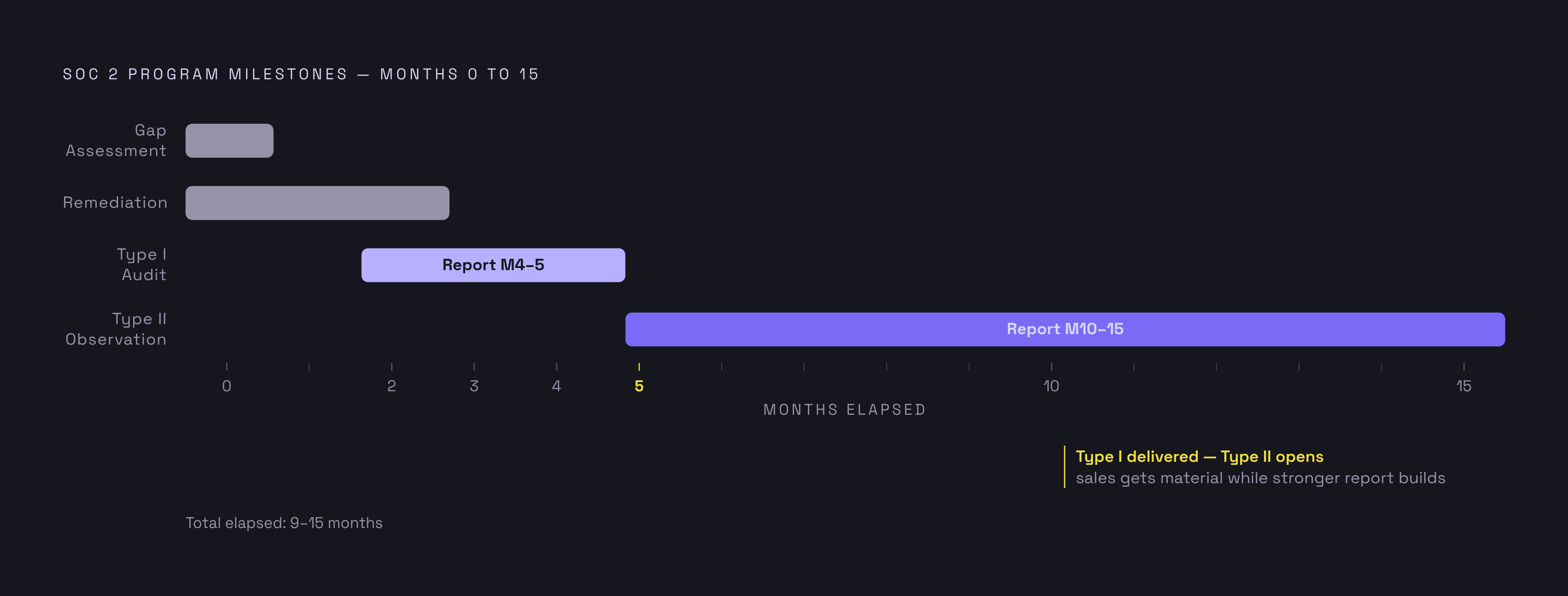
Still, a realistic middle road exists for a truly first-time program. Sales gets material to share sooner as the stronger report builds behind the scenes. No matter which route a company takes, that choice itself is the first milestone. The rest of the timeline depends on this decision being set first. Total elapsed time runs 3 to 6 months end-to-end with Type I; Type II runs 6 to 12 months, or, for a 12-month window, 9 to 18 months. First-timers often follow a common strategic path: wrap up Type I within the first few months, launch the Type II observation window right away, then deliver Type II by months 9–15, yielding a shareable result early while building toward the stronger report.
Defining the audit boundary
Once the report format is fixed, scope is what comes next, and it drives both cost and how much time the engagement takes. Availability, Processing Integrity, Confidentiality and Privacy are elective categories, with elective being the operative term. Including every one won't make a report look better to readers. It just makes the audit bigger, slower, and more expensive, without necessarily answering the question a buyer is actually asking. The right test is relevance: does this criterion match what the service actually does and what the report's readers will look for.
Scope, the TSC categories plus the infrastructure components included, drives cost above everything else in the program. Specialist CPA firms serving SaaS clients typically run $15,000 to $35,000 on a Type I and, for a Type II, $25,000 to $55,000; mid-tier national firms run $35,000 to $65,000 on Type II engagements, and Big 4 or other national firms run higher. A boundary stretched too far inflates every fee without benefit. A boundary set too tight makes buyers question if the report covers anything they need.
Scope covers more than just picking TSC categories. It also sets out the system boundary itself: apps, data, infrastructure, procedures, and staff covered by the audit, agreed with the auditor before final decisions. Scope is still evolving. As 2026 approaches, auditors increasingly want to know if an organization with AI tools in its offering has an AI governance framework and an AI evaluation procedure, a topic that was rarely raised in scoping conversations but is routinely discussed today. This phase should produce an agreed boundary document with the auditor that locks in what the readiness assessment will measure against.
The readiness assessment: where gaps are cheaper to find than during fieldwork
First-time SOC 2 organizations typically face a gap of 40% to 60%. Put differently, for most firms, roughly two-fifths to three-fifths of the required controls aren't ready yet. The readiness assessment exists to show where the gaps are, compare the control environment with the Trust Services Criteria, and build a prioritized roadmap for fixes and their order.
A lean crew with clear scope sees this assessment typically take two to four weeks, yet complex setups run past that; expect four to six weeks if everyone understands the boundary. Gaps spotted now cost only a fraction of what those identical gaps cost once they surface mid-audit, while the auditor's clock ticks and billing piles up.
A gap register noting missing controls without assigning an owner for each is merely documentation. A bare inventory never gets remediated on time. Each gap needs an owner and a due date. In first-time efforts, the tasks eating up the most runway include centralized logging deployment, MFA rollout covering each in-scope system, formalizing rules that live only in someone's memory, plus vendor assessments nobody has started.
Control implementation and remediation: the 8–12 weeks that determine whether the observation window opens on time
Rush it and the observation window slips, which throws every later milestone off course.
Auditors have a predictable short list of controls they test first, and it's worth knowing what's on it going in: role-based access control, MFA enforcement, automated provisioning and deprovisioning workflows, and quarterly access reviews. An active account still open for an employee who left the company months ago is a qualifying finding in nearly every audit, and it's the kind of gap that's trivial to fix and embarrassing to explain. Encryption gets checked against a clear floor, too: AES-256 for data at rest, TLS 1.2 or higher for data in transit, nothing softer passes.
Document drafting is typically the longest task in this window, more than most teams expect, since a written-down rule that's not enforced is a design-flawed control regardless of how well the document reads. And documentation discipline begins here, not during fieldwork. Even when a control runs correctly, no saved artifact means an exception follows as reliably as with one that didn't happen. At a 2025 readiness webinar, Linford & Company auditors pointed out: "The vast majority of first-time audit exceptions we issue trace to one of two things: access reviews that took place but never got logged as evidence, or change approvals that stayed in Slack rather than the ticket." The controls were running. They had no evidence. That gap between doing tasks and recording them is where remediation proves its value. Remediation typically runs 8 to 12 weeks from gap assessment completion to the observation period's start, and most teams underestimate this phase.
The length of the observation window
After remediation closes, the defining phase of Type II opens, which is absent in a Type I. Organizations can set a window at 3, 6, 9, or 12 months; 3 months is the minimum. For a first Type II, a shorter window helps: it finds control failures and hiccups during the audit period itself, well before issues have months to grow. The tradeoff is that some enterprise buyers treat a bigger window as stronger proof of steady performance.
Teams slip up when they treat this window as a break, a stretch where the tough part ended with remediation and all that's left is letting time pass. That gets it wrong. Controls need to work the same way across the whole window and produce proof each time, and auditors might run checks on automated or configured controls while the period itself is open. Access reviews, change records, vendor assessments, and logs have to accumulate continuously and remain retrievable instead of getting reconstructed once fieldwork kicks off. Teams that approach the window passively reliably end up facing exception-heavy findings. A documented control issue during this period won’t sink the audit. The final report lists it as an exception with the remediation taken and auditor's assessment, which isn't the same as a failed audit.
Fieldwork: what auditors do and request
Fieldwork is when the auditor's clock begins ticking against billable time, and how long it takes depends on how ready the company is at the outset.
What slows fieldwork follows a common pattern: late answers to the auditor's requests, materials kept in Slack rather than a ticketing system, plus access reviews done but not saved as artifacts teams can produce when asked. Konfirmity, drawing on more than 25 years and 6,000+ security audits, puts formal audit execution at 2 to 4 weeks for well-prepared engagements, while unprepared clients stretch it out.
The prepared-by-client list, the PBC list, arrives right at the start of fieldwork, and any team seeing it for the first time at that moment is already behind schedule. If the readiness assessment and remediation phases were run correctly, most of what's on that list should already exist, organized, and sitting somewhere the team can hand over within a day, not scramble to assemble over the following week. Type I fieldwork runs 2 to 5 weeks, during which the auditor reviews controls, interviews key personnel, and tests documentation as of the agreed audit date, and the auditor may request evidence before the official date to test certain controls ahead of time. Type II fieldwork takes 1 to 2 months when scoped well, and the auditor pulls transactions and evidence covering the whole observation period.
Report drafting, management review, and final issuance
Fieldwork closing isn't the end of the report, yet first-timers tend to skip this phase when planning. The auditor compiles the findings as a draft; the team isn’t simply handed a final report. First comes a review, and that takes time. The system description, report Section III, is the company's, not the auditor's; staff must confirm it or create it from scratch in this window instead of expecting the auditor to produce the work. Scrut says teams that overlook that the phase exists routinely underestimate their total timeline by one month, an expensive mistake when reps depend on a set delivery day.
Finding exceptions in a report doesn't mean a failed audit, yet first-timers often stall by attempting to fix items already documented appropriately, including the remediation taken and the auditor's assessment. Draft approval and final issuance require 3 to 6 weeks, depending on the firm's approach and how many revisions are needed. The final report is good for 12 months after the period close, and renewal starts upon issuance for organizations continuously working enterprise deals.
Putting the full timeline together: realistic ranges by scenario
Combined, the ranges group into a few scenarios based on the path each company takes. Organizations holding a prior report typically finish yearly renewals within 6 to 8 months because controls are live, proof gets gathered on an ongoing basis, and the auditor understands their environment.
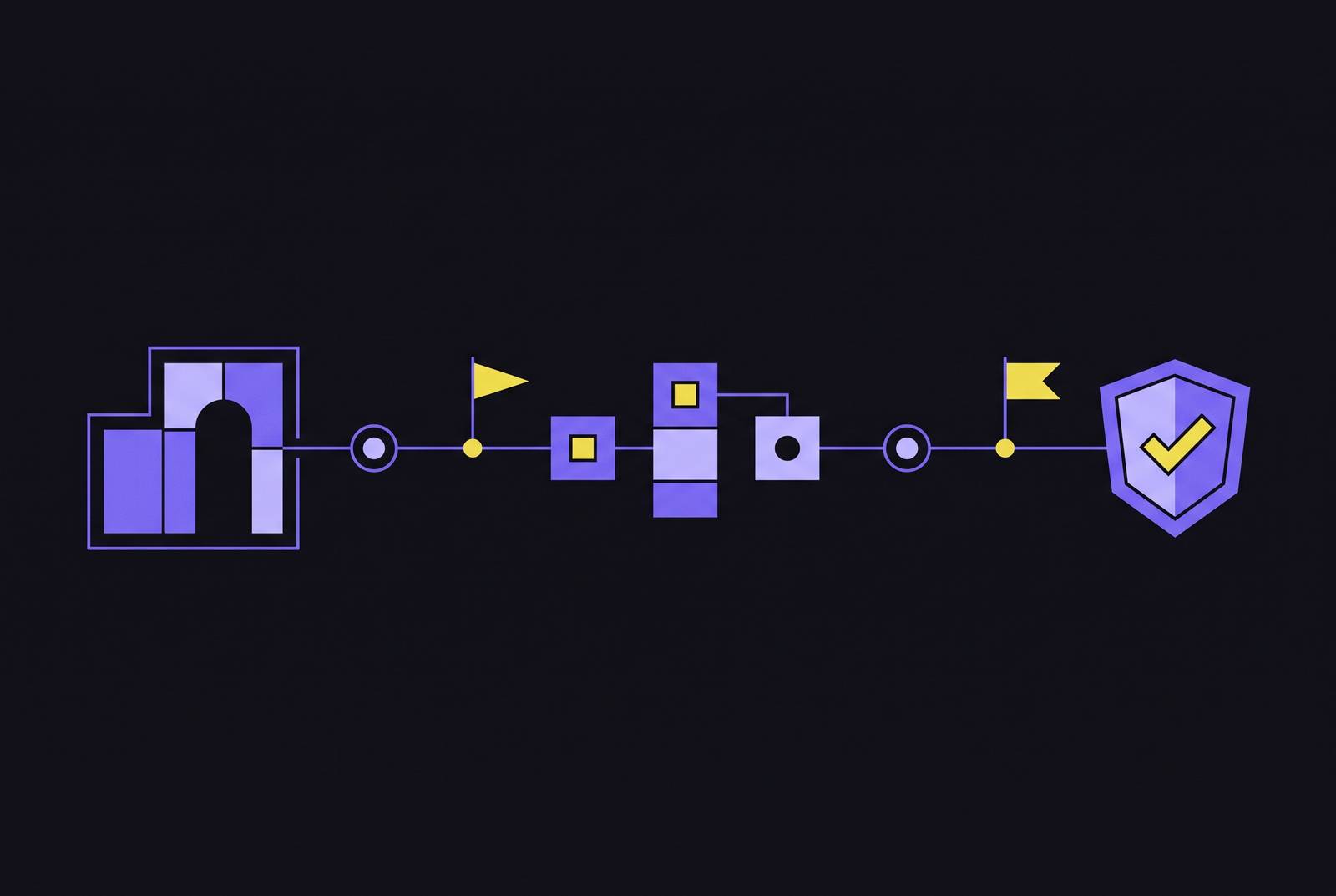
The sequence doesn't always hold. At a 60-person B2B SaaS company, the CTO held a Type I report, assuming it would satisfy an enterprise buyer deep in procurement. It wouldn't. The buyer demanded Type II, so the company had to restart its observation period from scratch, tacking months onto a sale that was otherwise done. That's the cost of sequencing badly: not a failed audit, just a contract stalled because nobody knew they still wanted one document. First-time Type II audits with a 12-month observation window take 9 to 18 months total. The common strategic path looks like this sequence: gap assessment at month 0; remediation closes and around month 2–3 the Type I audit opens; the report arrives around month 4–5; Type II observation window opens next; and Type II report arrives around month 10–15.
Automation compresses the timeline, mostly during the preparation phase, but it can't do the audit itself. After switching from spreadsheets to Scrut Automation, Contentstack took roughly two months less for its SOC 2 timeline, and some platforms say Type I readiness for that preparation period can be notably quick. Renewals are much quicker than the first once a company holds a report. A Type I run from scratch runs 8 to 14 weeks per soc2auditors.org, and most organizations finish in 3 to 6 months total once pre-engagement preparation is counted. For a Type II, first-time audit, the 3-month observation window means it takes 6 to 12 months total including preparation, observation, fieldwork, report drafting.
What a well-run first program looks like in practice
In each phase above, the pattern is the same: work speeds up when it follows the right order and slows down, sometimes a lot, when something is skipped or reversed. A well-run early effort brings the auditor in before remediation ends, not after, since auditors set audit boundaries and it’s better to catch issues then than during fieldwork, when time and billing have started.
Put someone's name on every gap register line rather than just listing the problem, because gaps in responsibility fail audits as often as missing controls do. And storage has to be part of the daily flow, not bolted on just before audit starts: with change approvals in their proper ticketing system, access outputs saved as retrievable artifacts, and incident logs kept after closure. Nothing here is hard. It's only tasks done by a clearly accountable owner, in the right sequence and at the right moment.